
Blog
8 May 2026

X is for…XII Club
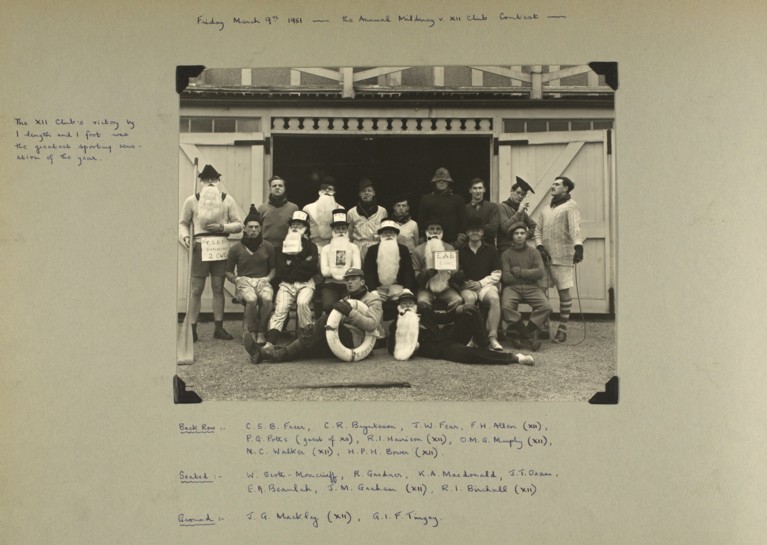
The most exclusive student clubs are, by definition, those with a limited membership, and the use of Roman numerals in their names adds an extra touch of class. Emmanuel had several such societies, the longest-lived of which was the XII Club. The Lent Term 1890 college magazine informed readers that ‘A literary society [had] been started among the first year men…at present it consists of twelve members, though it is not limited strictly to this number’. The club’s activities were originally twofold: firstly, to read classical plays aloud and secondly, to discuss essays written by club members. After a few years, though, its members decided to leave essay-writing to the Mildmay Club. The two societies continued to enjoy a friendly rivalry, however, competing against each other in an annual fancy-dress boat race (the caption to the 1951 photo reproduced above declares that the XII Club’s victory represented ‘the greatest sporting sensation of the year’). Perhaps motivated by brief flares of egalitarianism, one or two of the XII Club’s early magazine reports render its name as ‘Twelve’, but the use of Roman numerals always prevailed. The club lapsed during the Second World War but was re-founded in 1946 at the prompting of two college Fellows. The new members continued the club’s tradition of ‘reading plays and drinking beer – and coffee’. Edward Welbourne, Senior Tutor and later Master, dismissed the new incarnation as a bunch of ‘college toughs’! The XII Club’s upbeat report in the 1967-68 college Magazine declared that it had ‘flourished’ that year, having ‘profit[ed] greatly from the conversation, inhibition, lack of inhibition, and insanity of its new members’ (and, one suspects, the regular presence of guests from the women’s colleges). It is surprising, then, that the club appears to have become defunct almost immediately afterwards.
X is for… X-ray Crystallography
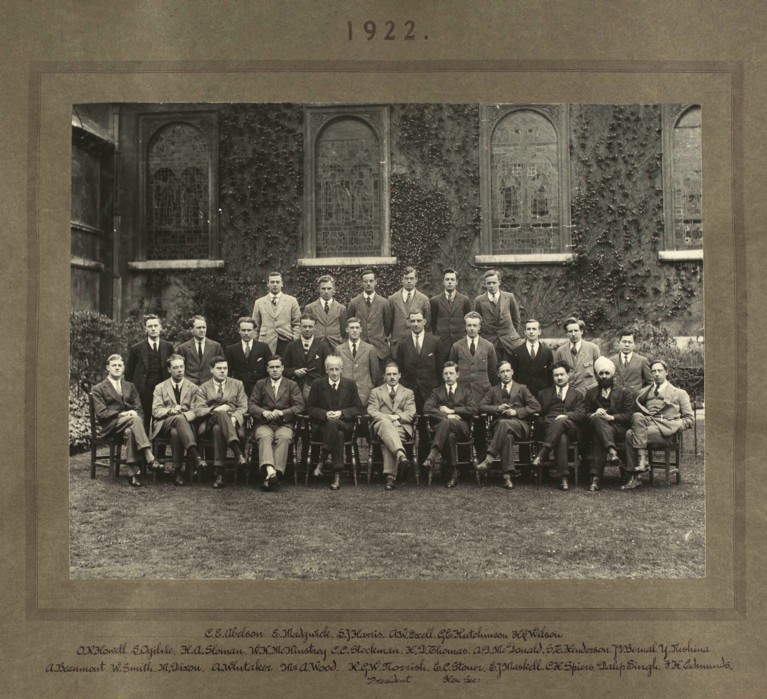
This discipline, involving the study of the atomic and molecular structure of crystals, has advanced tremendously in the last century. A pioneer in the field was John Desmond (‘Des’) Bernal, admitted to Emmanuel in 1919. Bernal (standing 2nd from the right, middle row, in this 1922 Emmanuel Natural Science Club photo) graduated with a First and went on to achieve international recognition for his achievements in the development and application of X-ray crystallography. According to his obituary in the 1971 college magazine, he was ‘an intellectual Marxist, fierce in argument but always gentle in manner, not a militant revolutionary’. All the same, Bernal’s robust support of Stalinism undoubtedly prevented him from receiving some of the honours that were his due. Abandoning pacifism in 1939, he made valuable scientific contributions to the war effort. In 1965 Emmanuel made him an Honorary Fellow, and in his letter of thanks Professor Bernal replied that he remembered the college ‘with the greatest affection and realise now what I owe to my training there’. X-ray crystallography was also the specialism of another remarkable Emmanuel man, David Elias. Admitted in 1938, he is thought to have been the first severely deaf student to be awarded a PhD. Elias later recalled that Cambridge’s supervision system was ‘almost as good as individual coaching’. He attended lectures ‘in the hope of getting something from the demonstrations by the lecturer and from the blackboard’ and sat next to friends ‘who let me copy their notes’. His interest in crystallography was formed at this time. After graduating in 1941, Elias worked as a technician at the Royal Ordnance Factory. Once the war was over, he enrolled as a research student at Leeds University, his doctoral thesis being entitled ‘An X-ray crystallographic study of trinitroethane’. Dr Elias later worked in the field of industrial research.
Amanda Goode, College Archivist