
Blog
17 September 2026

The portraits on Emmanuel’s walls – now over 150 in number – represent a serendipitous legacy from past donations, bequests and the occasional commission. Only since the late 1980s has Emmanuel even had a consistent policy of commissioning portraits of Masters. But there is one sub-set among the portraits that is evidently the outcome of a settled policy. These are the copies of portraits of various Emmanuel-related worthies, commissioned between 1775 and 1790 from a single artist – Joseph Freeman (1729-99) – and probably a reflection of sentiment associated with the College’s bi-centenary in 1784.
As a group, these eleven portraits can offer an intriguing snapshot of the predecessors that Emmanuel regarded as worth commemorating at that point in time. Needless to say, those chosen predecessors include some entirely forgotten as well as some still remembered. They include two philosopher-theologians, three other churchmen, a wealthy businessman and philanthropist, an eccentric astronomer, two recent and long-serving ‘college men’ (a tutor and a Master), and a prominent figure in the Civil War of the previous century (but they got the wrong one). Oddly at first sight, seven of these eleven portraits are copies of portraits that the College already owned. It would seem that the motive was to create a series of uniform size and uniformly framed to hang as a set in the Fellows’ Parlour. In accounts for 1788 Freeman is paid for five ‘Three Quarter Pictures at four guineas each’ and seven Carlo Maratta gilt frames for £12.12s.6d.
For the Parlour – which during the Mastership of Richard Farmer (1775-97) was something of an intellectual salon – a portrait of the College’s Founder was needed. Freeman slightly softens the grave, not to say pinched, expression of the forbidding Puritan assumed by Sir Walter Mildmay in all other known portraits.

But in his copy Freeman did not soften the College’s larger portrait of a grave-looking Francis Ash (fl. 1645-60), which is now in the Hall.

A City of London alderman, Warden of the Goldsmiths and Master of the Muscovy Company, Ash was never a student at Emmanuel but was an exceptionally generous benefactor to the College as part of his annual charitable donations totalling the then stupendous sum of £300.
The portraits of Benjamin Whichcote (1609-83) and Ralph Cudworth (1617-88) depict Emmanuel members of what are now called ‘The Cambridge Platonists’.

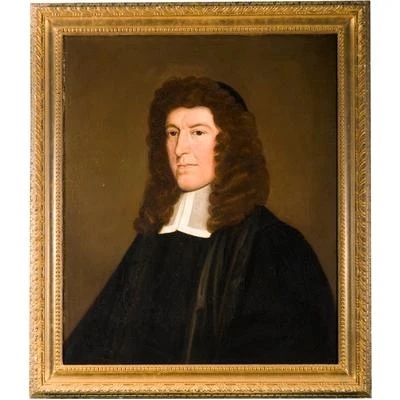
This group of Cambridge philosophers and theologians believed that religion and reason were in harmony and used reason to unite Christian belief with Platonism. Whichcote held that as the child of reason mankind is not wholly depraved by nature as Puritans believed, and argued for religious toleration. Cudworth was perhaps the most learned of all the Platonists, his magnum opus being entitled The True Intellectual System of the Universe. Freeman’s copies are very much shaped by the quality of the portraits that he was copying. For Whichcote, he had the College’s fine portrait by the pioneering woman portraitist Mary Beale to work from. For Cudworth, he had perhaps contemporary drawings that were later engraved, and the difference in inspiration is very obvious.
Similar variations deriving from the copy’s original are to be seen in three portraits of churchmen. John Sudbury (1604-84) had entered Emmanuel in 1620 and went on to be Dean of Durham (1661-84), repairing the cathedral fabric and building a library.
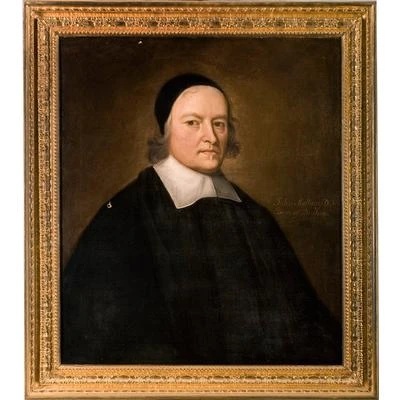
He endowed a Greek lectureship at Emmanuel and an annual prize (in silver) for the best commencing bachelor, which long continued as a prize in the form of silver. This is a copy of a copy: Freeman copied the College’s existing portrait, itself probably copied from one at Durham.
By contrast, the Freeman copy of the portrait of George Thorp (1638-1719), a major benefactor, reflects the excellent quality of the College’s original portrait by Mary Beale.

A third churchman is John Peter Allix (1679-1758), a local vicar, of nearby Swaffham Prior.

His only connection with Emmanuel was that his father, Pierre Allix, was a distinguished French Protestant divine, and refugee in England, who took a Cambridge Doctor of Divinity degree from Emmanuel in 1690 – it is tempting to think that Freeman copied the wrong Allix…
The same quality difference depending on the original marks two portraits of recent loyal College officers: William Richardson, Master for nearly forty years (1736-75) and Henry Hubbard (1707-78), a tutor for thirty five years.


With Richardson, Freeman is copying the College’s larger portrait, now in the Hall and probably by one of the van der Mijn family of Dutch artists working in England in the eighteenth century. With Hubbard, Freeman is copying a portrait by Gainsborough, possibly the year before its owner bequeathed it to the College.
There is also a quality from the original in Freeman’s copy of the portrait by the American artist Benjamin West of Roger Long (1680-1770), the first Lowndean Professor of Astronomy and long-serving Master of Pembroke.

Long had had only the briefest connection with Emmanuel at the start of his career, but was recruited to the portrait-pantheon of Emmanuel worthies. Perhaps this was because he was one of the great characters of eighteenth-century Cambridge, building a ‘water-work’ in his garden, around which he exercised, paddling on a ‘water-cycle’, and also constructing the first planetarium, a hollow sphere that could hold 30 people and showed the movement of the planets and constellations. It survived in the Pembroke gardens until 1871.
In the last of the set of copies, an attempt to include an Emmanuel figure from the Civil War period produced only a case of mistaken identity.

What Freeman copied for the College as a portrait of Sir John Finch, who entered Emmanuel in 1596 and was variously Commons Speaker, Chief Justice and Lord Keeper, actually turns out to be a portrait of Arthur Annesley, Earl of Anglesey (1614-86), who never had any connection with Emmanuel. The silver lining is that Freeman’s copy reflects the quality of the excellent original – now in the National Portrait Gallery – by the Anglo-Scottish painter John Michael Wright (1617-94), whose work is increasingly valued. Before photography, identification of sitters and attribution to artists was necessarily laborious and prone to error.
In c.1790 a survey of the pictures in Cambridge colleges records that the Fellows’ Parlour was decorated with six copies by Freeman, presumably in those smart matching frames: Sir Walter Mildmay, Francis Ash, Henry Hubbard, John Sudbury, George Thorp and Benjamin Whichcote. Nowadays the Robert Gardner Room displays an almost complete set of the Freeman copies as a permanent exhibition of this fascinating moment of Emmanuel remembering its past.
Barry Windeatt (Keeper of Special Collections)
15 September 2026
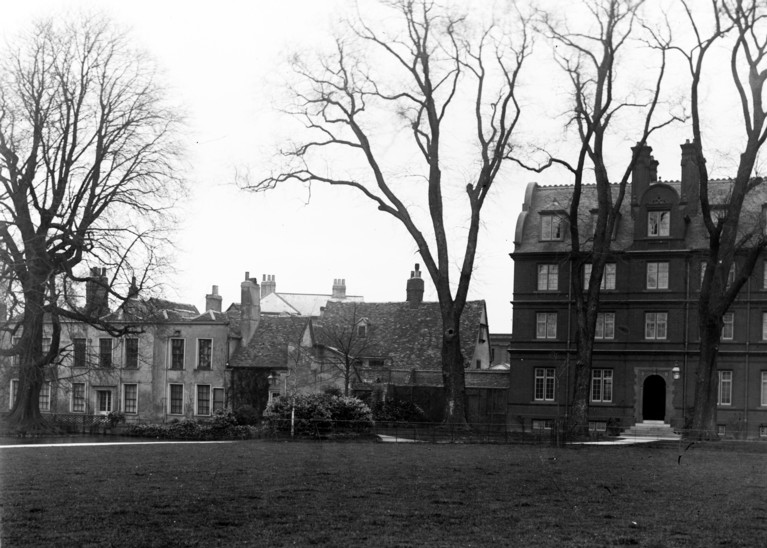
The college’s photograph archive contains a marvellous collection of plate glass negatives, created by Alfred Rose between c.1890 and 1914. Rose was a member of Emmanuel for 60 years, being admitted in 1859, becoming a Fellow in 1863, and dying in college in 1919. He also served as Bursar for some years, relinquishing the office in 1893. His photographs show parts of Emmanuel that rarely, if ever, featured in the postcards sold by the thousands in local shops, and are therefore a unique record of the college’s appearance in the late nineteenth and early twentieth centuries.
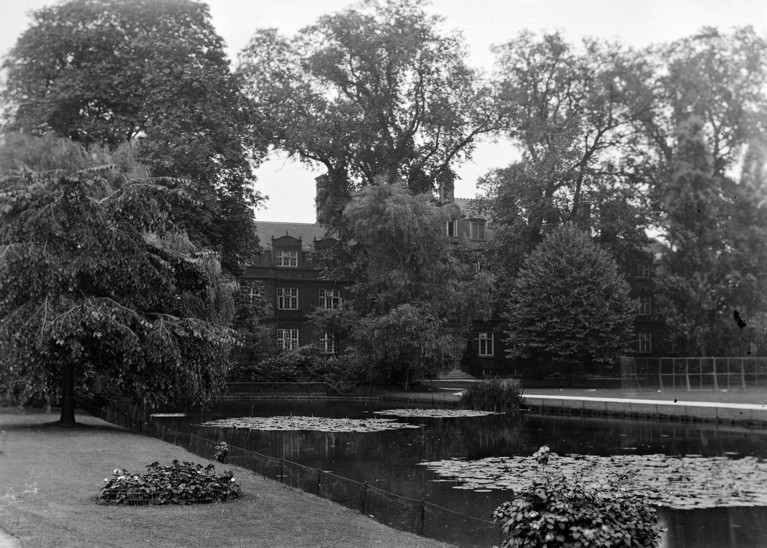
These two photographs show the lofty, red-brick Hostel. It was built in 1888 under the aegis of the Master, George Phear, to provide less-wealthy students with decent, if unluxurious, accommodation. The experiment was so successful that wings were added to both sides of the building in 1894. The new sections feature some very attractive ornate brickwork. The earlier photo was taken soon after the construction of the Hostel. It also shows Old Emmanuel House, a rambling and ramshackle old building that at some point had been given an incongruous and unconvincing Georgian façade. The later photo was taken after the Hostel’s wings had been added, an undertaking that had necessitated the demolition of Old Emmanuel House.
Amanda Goode, College Archivist
14 September 2026
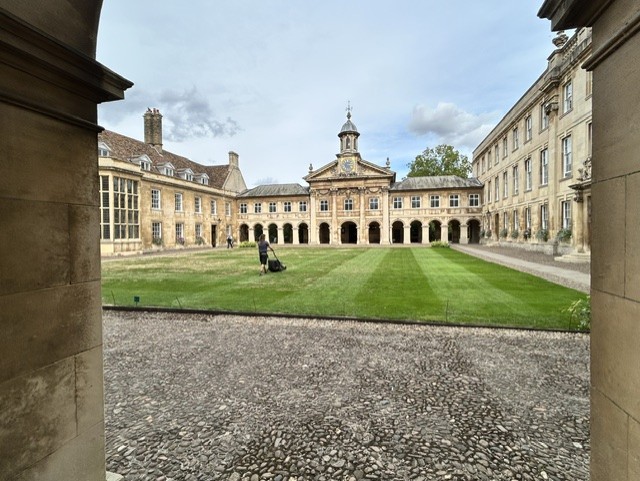
September has brought a welcome change of pace to Emmanuel College Gardens. After the prolonged warmth and dry conditions of recent weeks, the return to cooler temperatures has made the gardens feel refreshed, while the long-needed rainfall has brought real relief to lawns, borders, trees and shrubs. The difference is already visible: soils are beginning to regain moisture, foliage looks cleaner and brighter, and the whole garden has taken on a renewed sense of vitality.
Relief After the Dry Spell
The rain has been especially valuable for established trees and shrubs, which can continue to experience stress long after the hottest weather has passed. Although a few showers cannot fully replenish dry ground, steady rainfall is far more beneficial than a short, heavy downpour, as it has time to soak more deeply into the soil. The cooler days also reduce water loss through evaporation, allowing moisture to remain available to plant roots for longer.
Late-Summer Colour
September is a month of transition, but it is far from the end of the gardening year. Late-flowering perennials continue to provide colour and structure, while seed heads, ripening fruit and the first hints of autumn foliage add new interest throughout the grounds. The softer light at this time of year brings out the textures of ornamental grasses and foliage plants particularly well, and the gardens often look their best in the calm, clear conditions that follow rain.
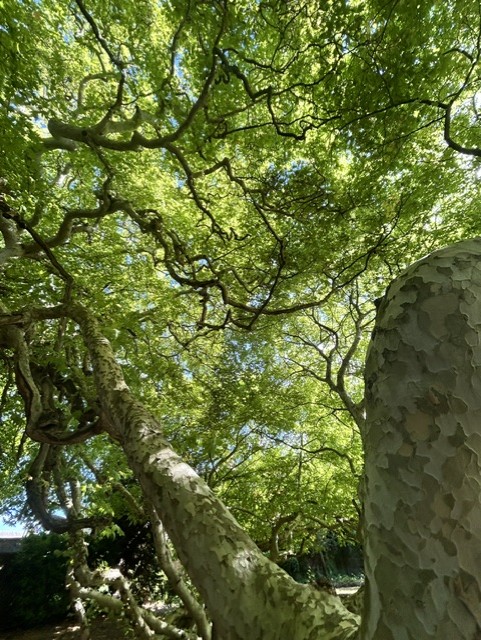
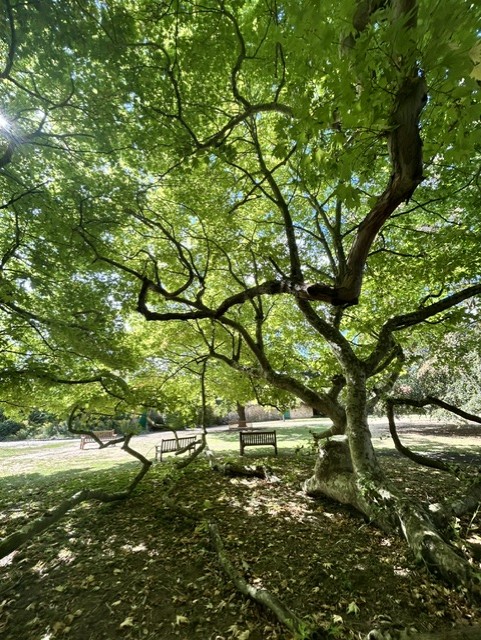
September Work in the Gardens
For the garden team, this is an important month for both maintenance and preparation. We continue to deadhead where this will prolong flowering, while allowing selected plants to retain their seed heads for structure, wildlife and winter interest. Lawns are responding to the rain and will gradually recover from the dry spell, although we remain careful not to work wet ground unnecessarily. We are also assessing planting areas, lifting and dividing suitable perennials, and preparing for the bulb-planting season ahead.
Traditional Care of the New Court Parterres
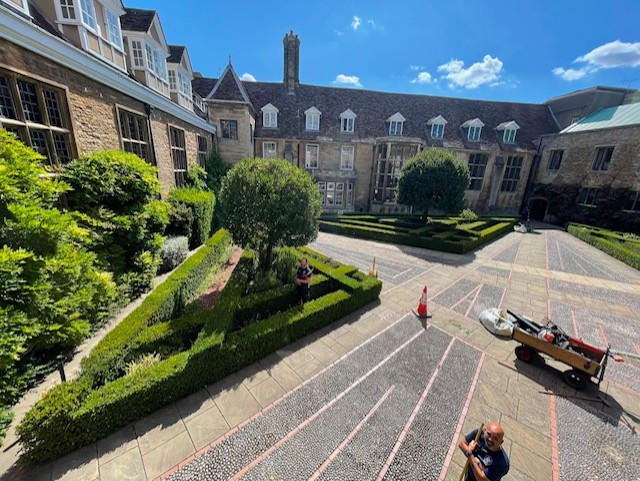
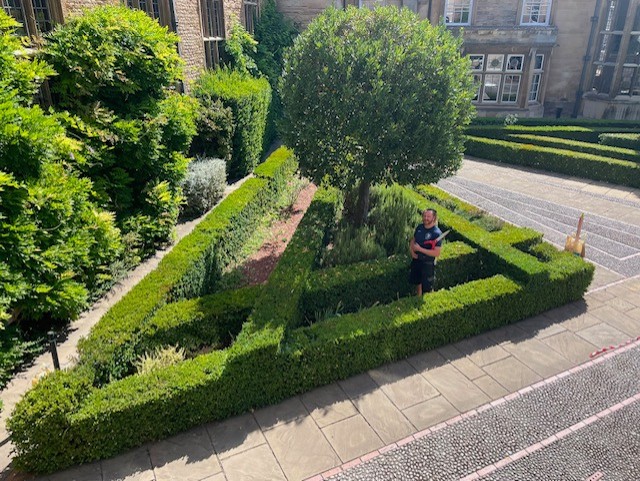
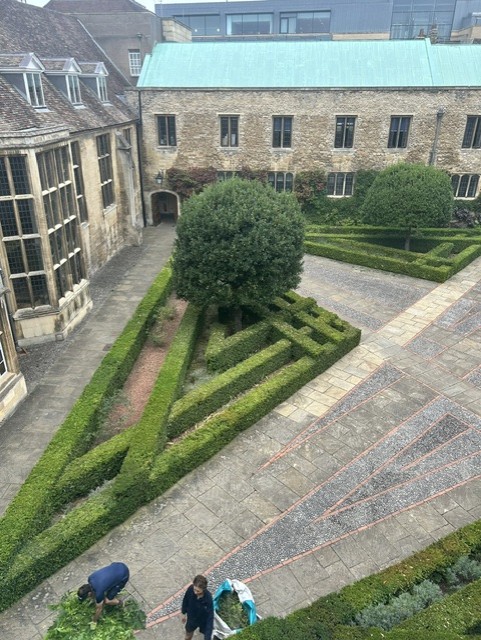
One of our most recent projects has been the annual trimming of all the box-hedge parterres in New Court. We continue to carry out this task using traditional methods, working only with hand shears and string lines. Although this approach is slower than using a powered hedge trimmer, it allows the garden team to make cleaner, more precise cuts. In turn, this helps to keep the hedges healthier and less vulnerable to box tree caterpillar attacks and box blight. Once trimming is complete, we follow up with regular applications of an organic foliar feed to support strong, healthy growth. The whole process takes around a week, but the crisp finish and long-term benefits to the plants make the results well worth the effort.
Connections Through Time
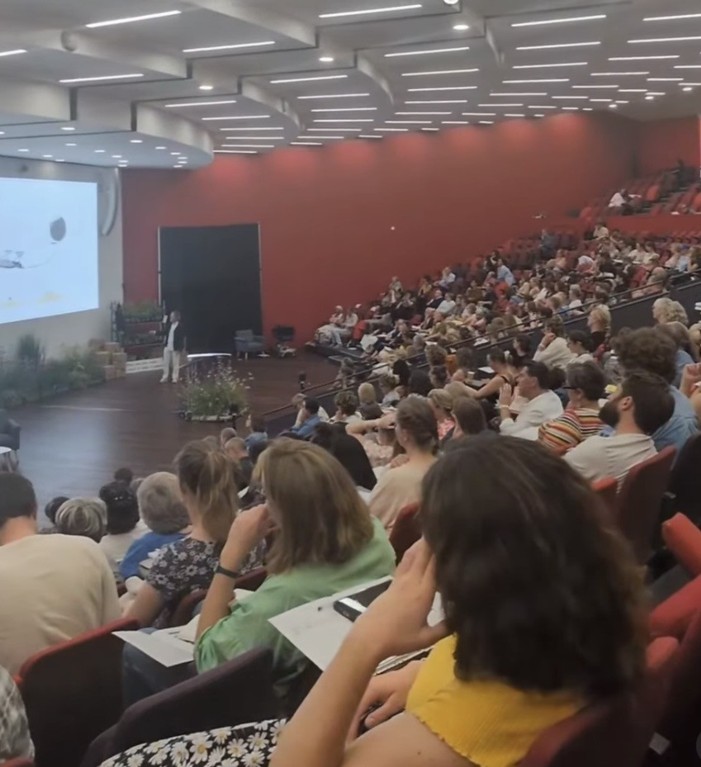
I recently attended the Beth Chatto Symposium, Connections Through Time, a three-day conference held at the University of Essex, exploring some of the most important issues facing gardens and landscapes today. The programme examined sustainable gardening, the management of landscapes through increasingly challenging climatic conditions, and how we should approach tree management for the future. It was an energising and thought-provoking experience, and I returned enthused by what I had learned. The symposium also provided valuable lessons that I will apply critically and practically in my role as Head of Gardens and Landscapes here at Emmanuel College, helping us to care for the gardens responsibly while preparing them for the challenges ahead.
Looking Ahead

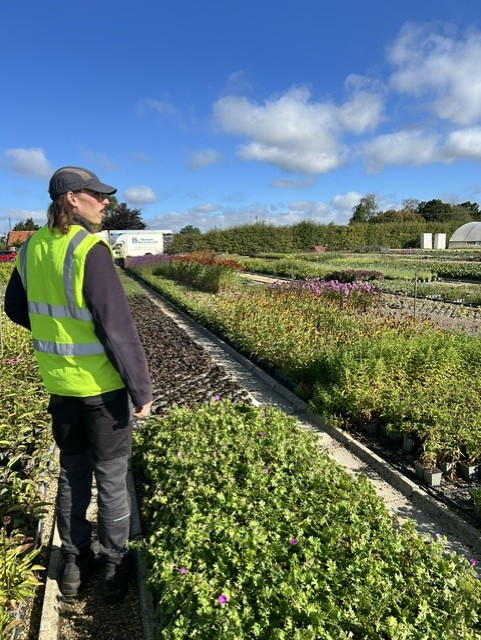
We recently visited Howes Nursery, a wholesale nursery, to begin planning replacement planting for specimens lost from the gardens during the drought. Being invited to view the current stock gave us an opportunity to assess both the quality of the plants and the standards under which they are grown. Selecting suppliers carefully is essential: healthy stock and good nursery hygiene give us confidence that we are purchasing from a responsible and reliable grower, while reducing the risk of introducing pests or diseases into the College gardens.

As the new academic year approaches, the cooler air and welcome rain have given the gardens a timely lift. September reminds us that a garden is always moving forward: summer displays begin to soften, autumn character starts to emerge, and the work we do now helps to shape the seasons to come. We hope that everyone passing through Emmanuel will take a moment to enjoy this refreshed and quietly changing landscape.
OTHER NEWS
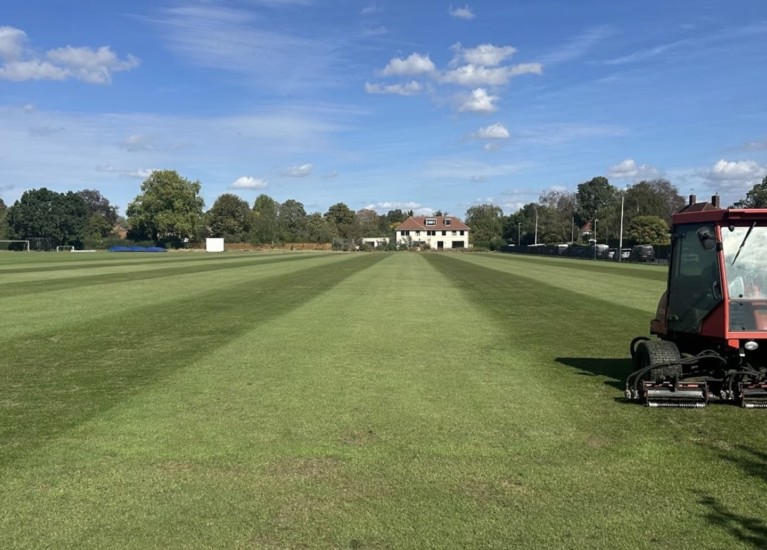
The sports ground renovations have now begun, with the cricket square currently being renovated under the stewardship of our fantastic new Head Groundsman, Will Stander. Will has been at Emmanuel for only a couple of months, but he is already doing a great job, bringing energy and expertise to the role. I believe the future of the Emmanuel College Sports Ground is in very good hands.


4 August 2026
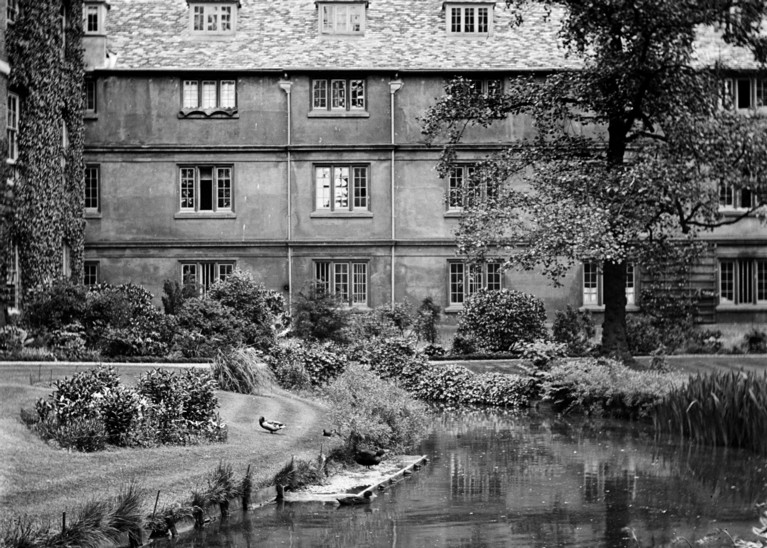
The college’s photograph collection contains a marvellous collection of plate glass negatives, created by Alfred Rose between c.1890 and 1914. Rose was a member of Emmanuel for 60 years, being admitted in 1859, becoming a Fellow in 1863, and dying in college in 1919. He also served as Bursar for some years, relinquishing the office in 1893. His photographs show parts of Emmanuel that rarely, if ever, featured in the postcards sold by the thousands in local shops, and they are therefore a unique records of, the college’s appearance in the late nineteenth and early twentieth centuries.
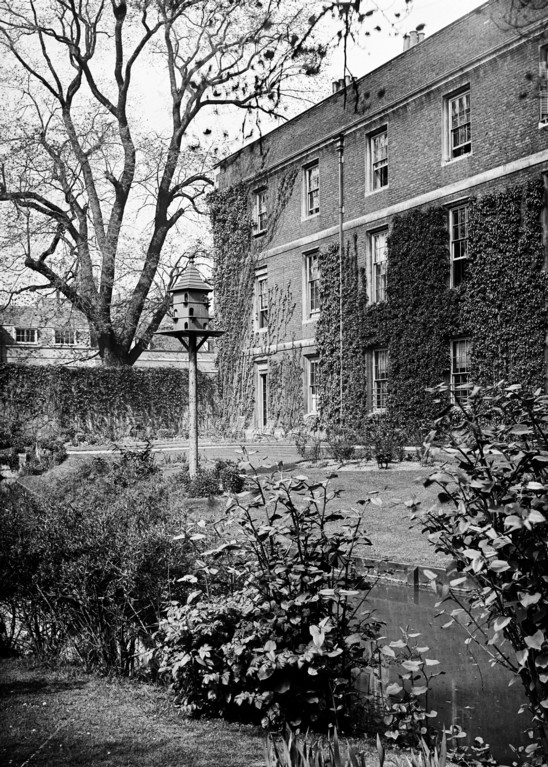
These two photographs show the garden before and after the erection of the ornamental dovecot in 1890. Note the ornamental wooden window box on one of the Old Court windows, and also the stucco on its façade. This was later removed because of water penetration.
Amanda Goode, College Archivist
3 August 2026
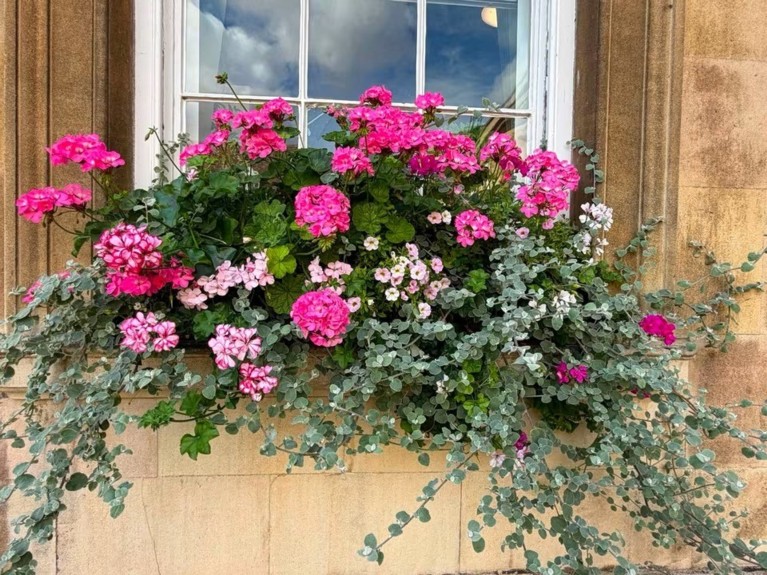
If you've wandered through the College gardens this month, you may have noticed that, despite the heat, everything is still looking remarkably colourful (apart from the lawns). I can assure you that hasn't happened by accident.
July has been one of the most challenging months we've faced in the gardens for many years. After almost a month without any meaningful rainfall, Cambridge Water introduced a hosepipe ban to help protect our local water supplies and the precious chalk streams that make this part of the country so special. Like everyone else, we've had to adapt, and overnight our watering routine changed completely.
Every plant that now receives water does so from a watering can.
It sounds simple enough, but across a site the size of Emmanuel College it's a huge undertaking. Instead of turning on a hose, every can has to be filled, carried, emptied and repeated, countless times throughout the day. It certainly makes you appreciate just how much water a garden needs during prolonged hot weather.
.jpg)
The biggest challenge has been deciding where our efforts are best spent. Unfortunately, it's impossible to water every corner of the gardens by hand, so we've had to prioritise newly planted trees and shrubs, containers, hanging baskets and those plants that simply wouldn't survive another week of this heat. Established trees and borders are having to fend for themselves, relying on deep roots and a little resilience until the weather changes.
Of course, the weather doesn't stop the College calendar. July is one of our busiest months, with weddings, garden parties and receptions taking place across the grounds. While some of the team have spent hours carrying watering cans, others have been preparing the lawns, borders and courts to ensure every event takes place in gardens that Emmanuel can be proud of. It's been a constant balancing act between keeping plants alive, presenting the gardens at their best for visitors, and still finding time for all the routine jobs that never disappear—mowing, weeding, hedge cutting and general maintenance.

There have certainly been moments when we've wished for just one good day of steady rain.
Living and gardening in Cambridge, we are used to drier conditions than much of the country. In fact, Cambridge receives only around 570 mm of rainfall in an average year, making it one of the driest cities in the UK. This year, however, has been particularly difficult. A dry spring followed by weeks of hot weather has left the ground baked hard, with very little moisture remaining beneath the surface. Even when showers have appeared on the forecast, they've often passed us by.
As frustrating as the hosepipe ban has been for gardeners, I fully understand why it has been introduced. The water beneath our feet doesn't just supply our taps; it also feeds the remarkable chalk streams that flow through our region. These streams are globally rare habitats, home to species that depend on cool, clean groundwater. During prolonged dry weather, every litre we can save helps reduce pressure on the aquifers that sustain them. As custodians of a historic landscape, we have a responsibility not only to care for the gardens but also to look after the wider environment that supports them.

Climate change is making these long, hot, dry spells feel less like exceptional events and more like something we have to plan for every summer. As gardeners, we're continually adapting. We're improving our soils to retain more moisture, mulching wherever possible, choosing plants that are better suited to warmer conditions, and thinking carefully about how we use every drop of water. Gardening is changing, and we have to change with it.
Despite everything, there have still been real highlights this month. The roses have been exceptional, many of the herbaceous borders continue to provide wonderful colour, and some of our more drought-tolerant planting has positively thrived in the sunshine. Perhaps that's one of the joys of gardening—you learn that nature is remarkably resilient, even when conditions are less than ideal.
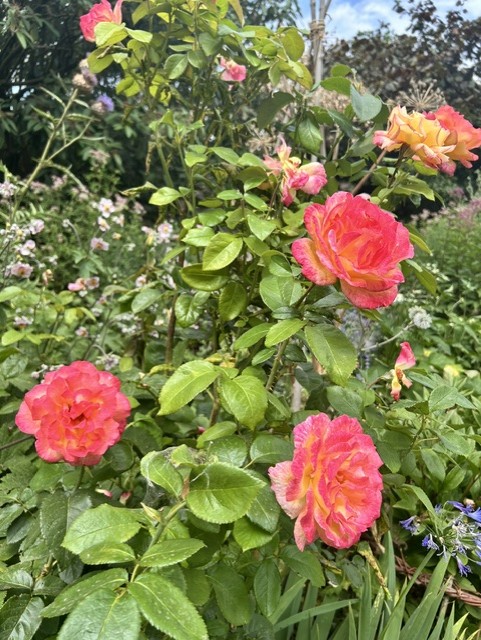
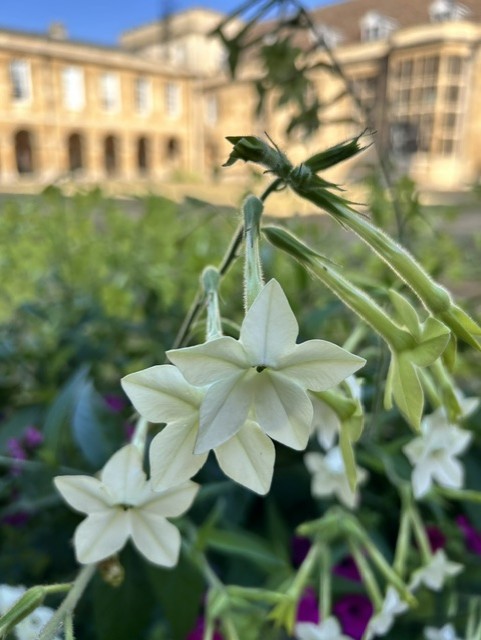
I'm incredibly proud of the gardens team. They have worked tirelessly throughout this difficult spell, often spending hours carrying watering cans before moving straight on to preparing the grounds for College events. Their dedication and good humour have ensured that Emmanuel's gardens continue to look their best, even under some of the most testing conditions we've experienced.
Like every gardener, I'm now looking skywards and hoping August brings us something we've all been waiting for—a few days of gentle, soaking rain. Until then, if you see one of us making yet another trip across the courts with a watering can in hand, you'll know exactly why.
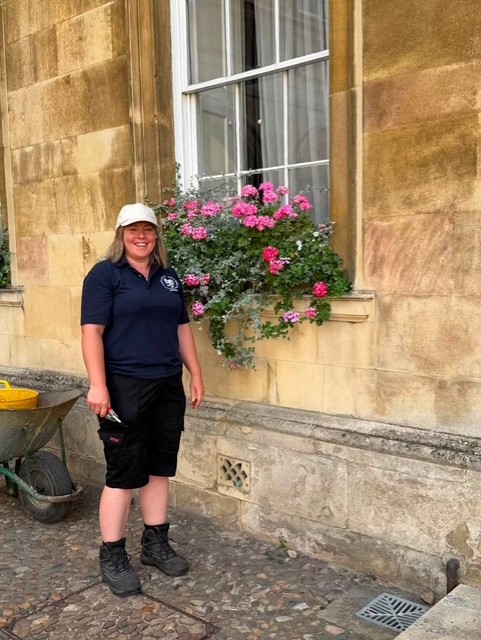
In August, the team say Bon Voyage to our Wrag’s trainee, Elizabeth Harvey. Elizabeth has completed here one year placement here at Emmanuel college. Elizabeth has been a joy to work with, and the team wish her every success in the future, continuing with her floristry business and working part time at Homerton College in the gardens. She will continue her RHS studies and remain a friend of the college for life.
Good Luck!!!
7 July 2026

Plate 1. 'Iron Works, Coalbrookdale', in P. J. de Loutherbourg, 'The Romantic and Picturesque Scenery of England and Wales' (London, 1805).
Rather a lot has been heard in recent weeks about ‘the North’, although many might retort: ‘Only not my bit of the North’. Indeed, apart from the stereotype of the North as defined by industrialized and now post-industrial conurbations – ‘It’s grim up north,’ etc – there has always been a variety of perceptions of the North of England. This is reflected in images of the North in Emmanuel’s collection of illustrated books. These pre-date the onset of heavy industrialization, but are alert to its beginnings in their time. There is wistful recording of destruction of old buildings and old ways in ancient towns, and the cult of the Lake District is already well under way, with books illustrating scenery in Cumberland, Westmorland and parts of Lancashire. The contemporary quest for the picturesque and the sublime begins to find inspiration in the North’s rugged upland scenery elsewhere than the Lakes. Yorkshire is illustrated, but there is little as yet on Northumberland or Durham.
Perhaps because of its early date, a book on the environs of Manchester focusses on distant views of towns and country houses. In its general prospect of Manchester itself the urban skyline is only faintly visible in the distance, framed by trees.

Plate 2. 'View of Manchester', in J. Aikin, 'A Description of the Country ... round Manchester' (London, 1795).
However, a justly celebrated book illustrating the costume of Yorkshire includes the blighted landscape of coalmining. Another plate shows child workers – their faces blue-grey – in front of a mill with a chimney belching smoke into the sky.

Plate 3. 'The Collier', in Graham Walker, 'The Costume of Yorkshire' (London, 1814).
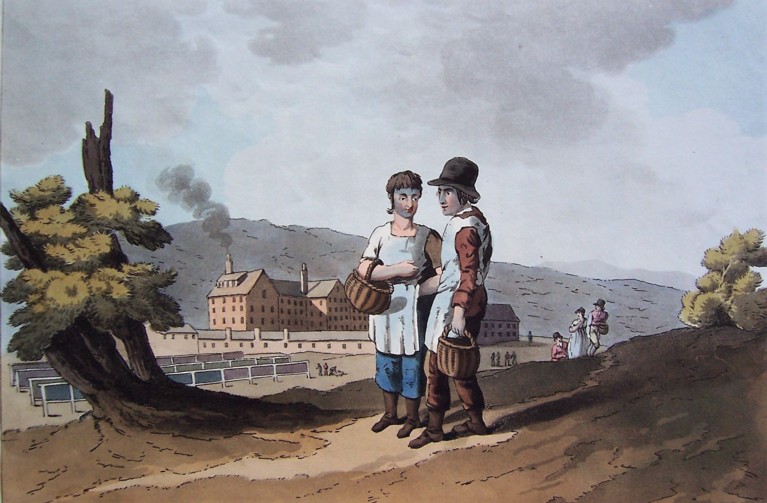
Plate 4. 'Factory Children', in Walker, 'Costume of Yorkshire'.
A number of books set out to record the townscape of Northern towns. A book devoted to uncoloured lithographs of Halifax depicts a number of quaint streets and half-timbered buildings, while recording that these have recently been demolished.
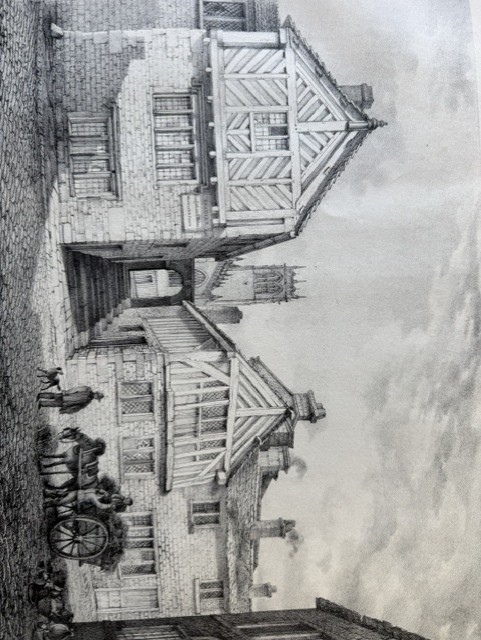
Plate 5. 'Old houses in Lower Kirkgate, taken down 1825', in John Horner, 'Buildings in the Town and Parish of Halifax' (Halifax, 1835).
Another early venture in lithography records the market place of the small Yorkshire town of Settle, depicted with locals going about their business.
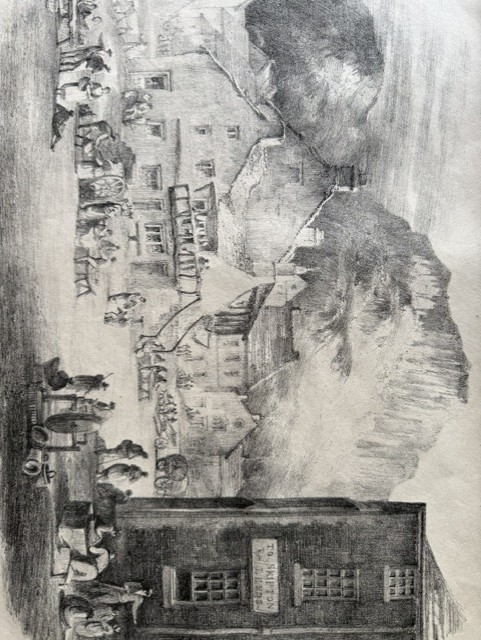
Plate 6. 'Settle, from the Market Place', in G. Nicholson, 'Six Views of Picturesque Scenery in Yorkshire' (Malton, 1822).
A book devoted to images of Carlisle sets out, in an elegiac spirit, to depict the place as it would have been a hundred years before and – while lamenting the demise of the town’s ancient guilds – includes a striking picture of their banners displayed in the street.
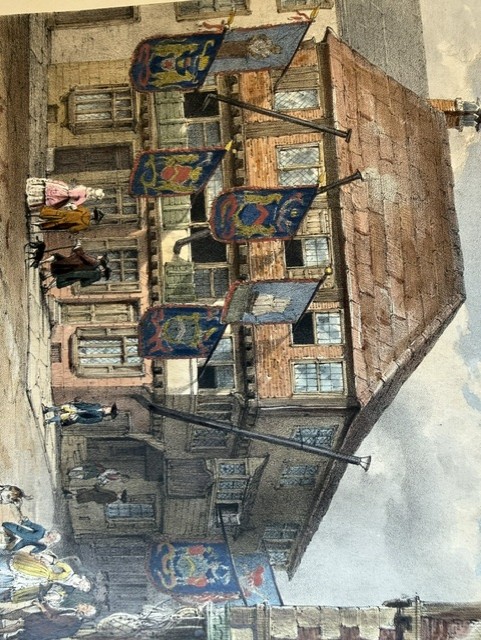
Plate 7. 'Trade Guilds', in M. E. Nutter, 'Carlisle in the Olden Time: A Series of Views of Ancient Public Buildings' (Carlisle, 1835).
The picturesque coastal position of Scarborough or Whitby enables the civic topographical impulse to place townscapes on record to be combined with something picturesque.
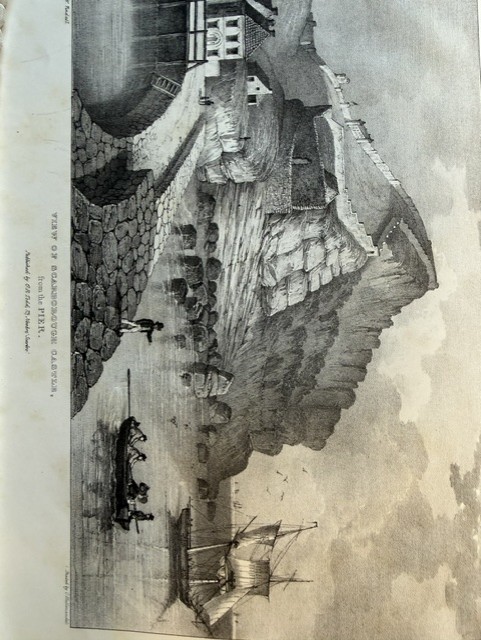
Plate 8. 'Views of Scarborough' (c.1828).
Indeed, the drama of a shipwreck on the coast near Scarborough can be one of the subjects included in a book assembled to exemplify how the work of contemporary water-colour artists can be made available to a wider audience through the colour-plate medium.

Plate 9. 'Shipwreck on the Black Rocks, near Scarborough', in 'A Selection of Fac-Similes of Water-Colour Drawings from the Works of the Most Distinguished British Artists' (London, 1825).
Another plate in the same book and by the same artist depicts what was a celebrated Northern beauty spot, the Dropping Well at Knaresborough in Yorkshire, where the water fell picturesquely in a kind of curtain of droplets, beautifully caught by both artist and printmaker.
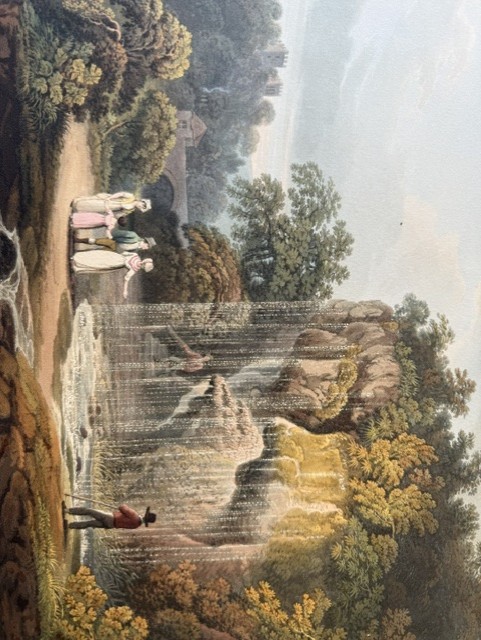
Plate 10. 'The Dropping Well at Knareborough', in 'A Selection of Fac-Similes'.
More dramatic is an attempt to capture in lithography the spectacular drop of the waterfall at Mallyan Spout on the North York Moors, published locally like many of these books on Northern subjects.
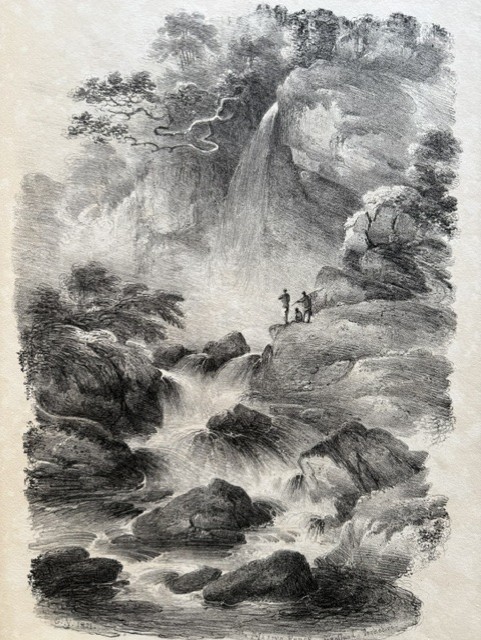
Plate 11. 'Maling Force' (now called Mallyan Spout), in G. Nicholson, 'Six Views of Picturesque Scenery in Goathland, Yorkshire' (Malton, 1821).
Meanwhile the sweeping upland landscapes of the North were joining the Lakes as objects of picturesque pilgrimage and as the subjects of illustration for armchair pilgrims. One example among many would be Bolton Abbey in Wharfedale, where romantic ruins might be one focus for far-reaching views. John Burkill is one artist who devotes an illustrated book to this landscape.

Plate 12. 'View of Barden Tower, near Bolton', in John Burkill, 'Bolton Illustrated: A Series of Views of the Scenery around Bolton Abbey' (London, 1848).
T. Hofland is another, recording scenes in normal daylight while also striving – as various contemporary artists did – to capture the mysterious effects of light at dusk which are so appropriate for the pensive contemplation of ruins in a landscape.
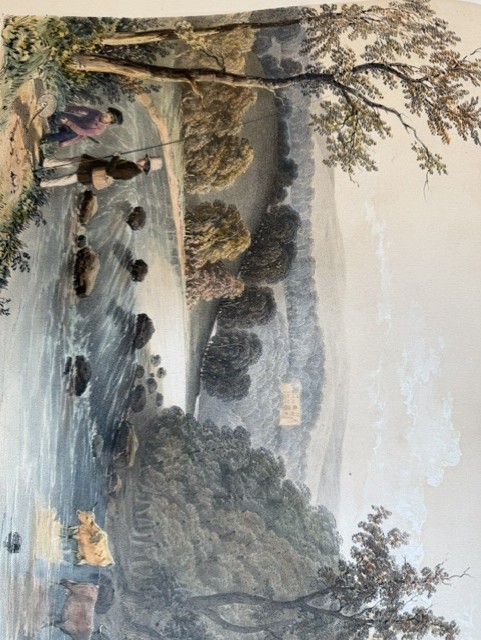
Plate 13. 'View of the Wharfe, near Bolton Priory', in T. C. Hofland, 'Six Views of Bolton Priory' (1811).

Plate 14. 'Bolton Priory, Twilight', in Hofland, 'Six Views'.
It is probably no accident that Emmanuel’s Graham Watson Collection is so rich in illustrations of the North of England, since their collector, Graham Watson, a patriotic Yorkshireman and Bradfordian, was both a great lover of all the Northern uplands and a public-spirited contributor to the civic life of the North.
Barry Windeatt (Keeper of Rare Books)
7 July 2026
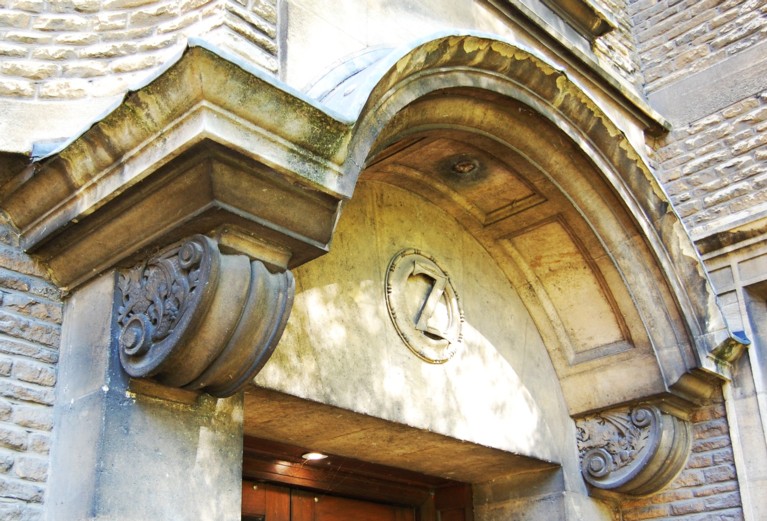
The factor linking these two disparate-sounding entities is the architect Leonard Stokes, who designed two acclaimed buildings at Emmanuel: the Library (formerly the New Lecture Rooms) and North Court, completed in 1909 and 1913 respectively. Both buildings were adorned with carvings of the highest quality. Those in North Court were the work of London-based sculptor Abraham Broadbent, and as Stokes used his services frequently, it seems likely that Broadbent had also executed the Library carvings. The most attractive of these are the twelve bas-relief stones, depicting the signs of the Zodiac, set into the arches over two of the ground floor windows. The college considered them to be ‘a charming piece of sculpture, which not all members…have noticed as they deserve’. North Court’s carvings are equally eye-catching, especially the heraldic monsters supporting the cambered hoods over the staircase entries. These fearsome-looking beasts are carved in the same bas-relief style as the Zodiac sculptures, and fun can be had distinguishing between dragons, gryphons and wyverns. North Court stairways Q, R, S and T were ready for occupation by Michaelmas 1913, but X, Y and Z were not finished until the summer of 1914. (Letters U, V and W were omitted as they were thought to be too similar-looking, but in the 1960s ‘W’ was assigned to the staircase in the North Court porters’ lodge, after it had been converted to residential use.) Several sets in the court were reserved for Fellows, one of the most gracious being Z8 (now Z16). It was occupied for most of the period between 1914 and 1948 by Leonard Greenwood, a New Zealander appointed in 1909 to teach Classics. The informal drop-in musical evenings he hosted in Z8 every Sunday became a college institution.
Z is for Zumpe piano
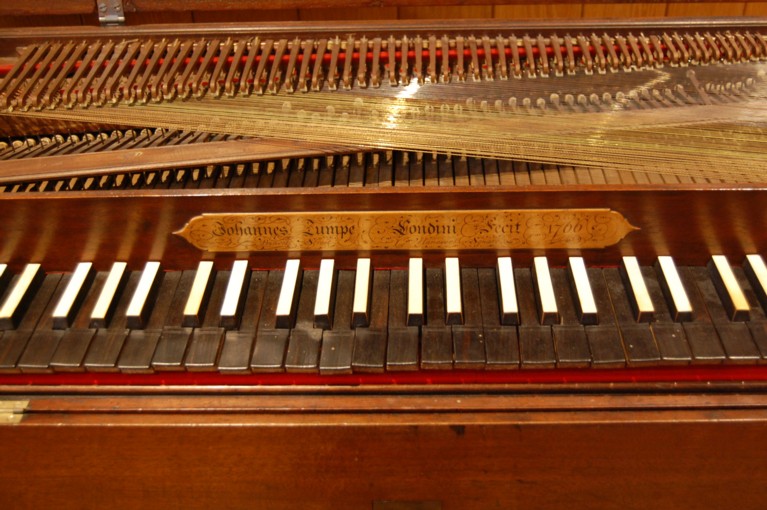
In a corner of a music room in the Queen’s Building stands an instrument of humble appearance, but great historical significance. Manufactured in 1766, it is one of the oldest surviving English-made ‘square’ pianos. The maker was German-born Johannes Zumpe, who emigrated to London in about 1760 and set up a musical instrument shop near Hanover Square. The piano was given to the college in 1985 by the sons of Edward Woodall Naylor. In 1898, their father had been appointed Emmanuel College organist and lecturer in music, a unique appointment in Cambridge at that time. Emmanuel made him an Honorary Fellow in 1920. Naylor’s principal interest was in early music, which was then a rather unfashionable field of study. His hand-drawn posters showing seventeenth-century musical instruments and musicians, which he used as lecture aids, are preserved in the college archives. He was also a composer, and his music MSS are held in the library’s special collections. According to Naylor, the Zumpe piano ‘was bought when new by my maternal ancestor, the horticulturalist [William] Bean, who kept a garden with a concert hall at Scarborough in the mid-Eighteenth century’. Naylor’s sons took great care of the piano after their father’s death in 1934, but eventually decided that it should have a permanent, secure home at Emmanuel College. The instrument required some restoration, and its strings and some wooden innards had to be replaced, although they have been carefully preserved. Unfortunately, the piano is not currently in working order. The three earliest surviving Zumpe pianos bear the date 1766, and two of them, including Emmanuel’s, are evidently experimental prototypes.
Amanda Goode, College Archivist
6 July 2026
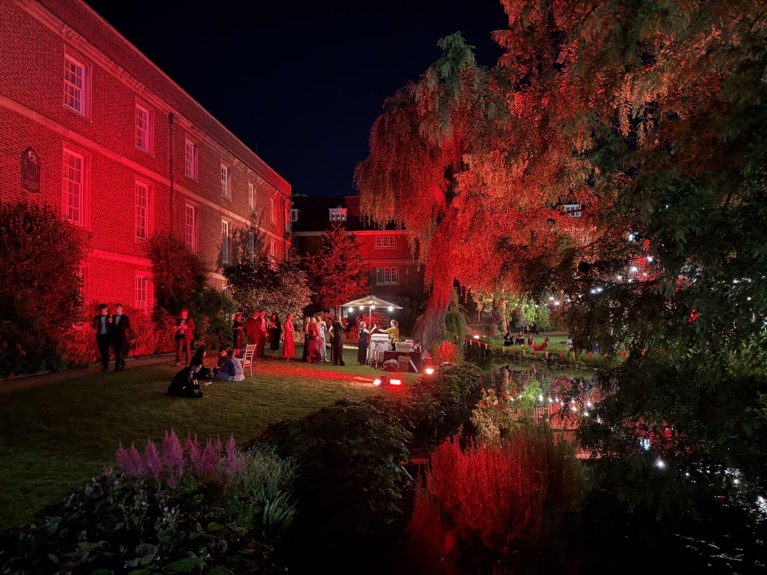

July has certainly tested both the gardens and the gardening team. We have experienced an exceptionally hot spell, with record-breaking temperatures and very little rainfall. While the sunshine has been welcomed by many, it has presented significant challenges for the gardens, with prolonged periods of heat placing considerable stress on plants, and particularly our lawns.


Despite the conditions, the garden team has worked tirelessly through the heat to ensure the College grounds looked their very best for the May Ball and the many garden parties that have followed. These events showcase Emmanuel at its finest, and it has been immensely rewarding to see the gardens enjoyed by so many students, Fellows, alumni and guests. It was fantastic to see the gardens illuminated at night, showcasing the structure of the trees and setting the party mood. As the garden party season now draws to a close, our attention turns to preparing the gardens for the forthcoming wedding season, when the College will once again welcome visitors to enjoy its beautiful surroundings.


There is much to celebrate in the gardens now. The waterlilies on Tyler's Garden Pond are putting on a magnificent display, providing a calm and colourful focal point. The herbaceous borders are now at their summer peak, bursting with vibrant colour and attracting a wealth of pollinating insects. The shady raised border by Mike's Bar is also looking particularly good, demonstrating that thoughtful plant selection can thrive even during challenging weather conditions.
The greatest casualty of the prolonged heat has undoubtedly been the lawns. Following the May Ball, we worked hard to repair and green up Front Court Lawn in time for graduation, and for a short while the results were very encouraging. However, sustaining healthy grass in temperatures approaching 35°C, with virtually no rainfall, is an uphill battle. While the lawns may currently appear tired and parched, grass is remarkably resilient, and with cooler weather and some sustained rain, we are confident they will recover well.
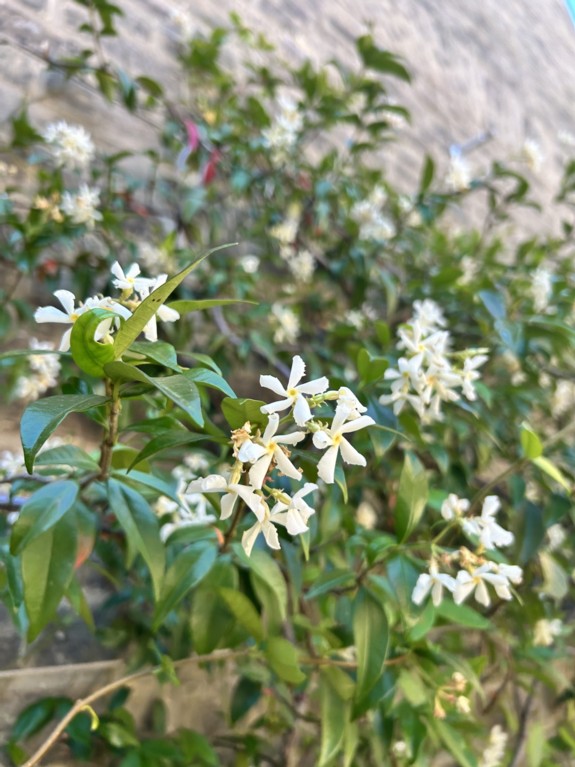
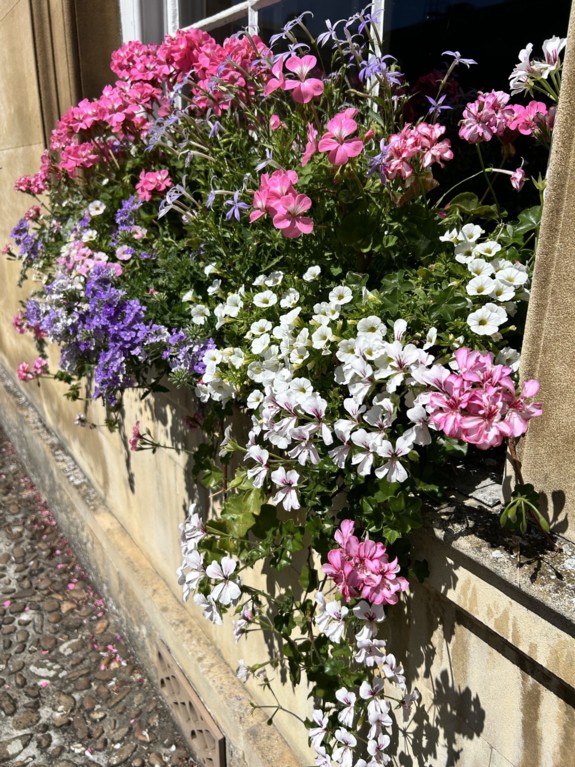
While the lawns inevitably draw the eye when they begin to brown, our greatest priority during periods of prolonged heat is always the trees, particularly those planted within the last few years. Newly established trees have yet to develop the extensive root systems needed to find moisture deep within the soil, making them especially vulnerable during hot, dry weather. Rather than frequent light watering, we give these trees regular, deep soakings, encouraging their roots to grow downwards in search of moisture. It is a time-consuming process, but one that is essential if we are to give our young trees the best chance of thriving for decades to come. In many ways, the effort invested now is an investment in the future landscape of Emmanuel's gardens.
As always, I would like to thank the garden team for their dedication, resilience and hard work during what has been an exceptionally demanding few months. Their efforts continue to ensure that Emmanuel's gardens remain a wonderful setting for college life, whatever the weather brings.


The garden and grounds team will also welcome a new team member this month. The college have recruited a new Head Groundsman at our Sportsground in Wilberforce Road. We welcome Will Stander to join our team from Girton College. Will joins us at an exciting time for the college sports teams. Will brings with him experience and is full of very exciting ideas. There will be more news on Will when he has settled in a bit but watch this space. The garden department are exciting to work alongside Will and embrace with him as part of everyday college life here at Emma and at Wilberforce Road.
With thanks to Emma Experience Director, Daniel McKay for the May Ball 2026 photos.
9 June 2026
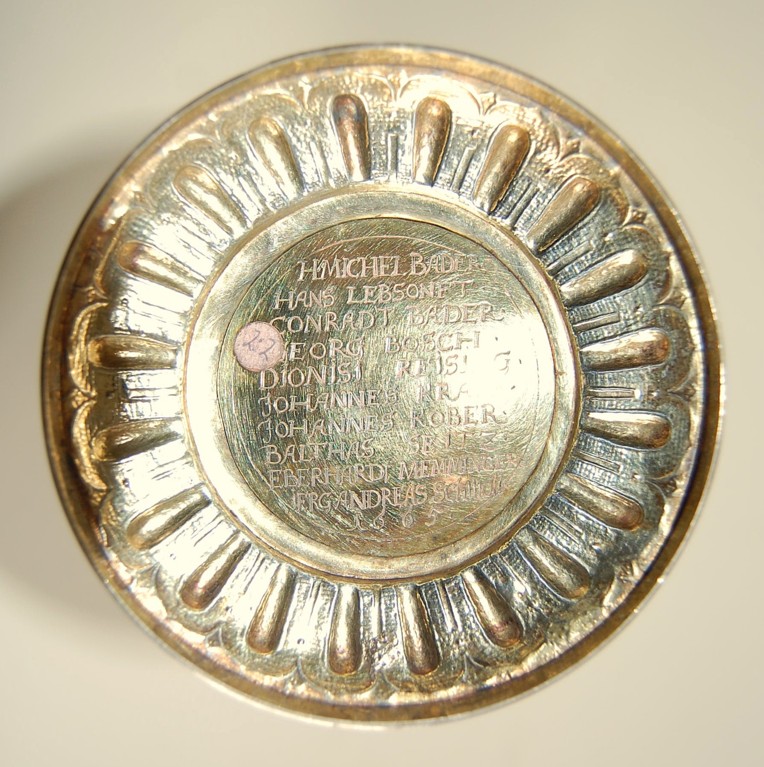
Y is for…Yeatman Cup
The exact date on which the Emmanuel College Athletics Club was founded is unknown. It was certainly flourishing by the mid-1860s, because in 1868 it was given a silver cup, to be awarded to the best all-rounder in the annual athletics competition. The donor was Huyshe Wolcott Yeatman, who had just graduated BA from Emmanuel. The ‘Yeatman Challenge Cup’ bears the hallmarks of Schemnitz (Slovakia) and incorporates a disc inscribed with ten German personal names and the date 1665 (pictured). The Emmanuel winners of the cup were recorded on a bespoke base, but there is a gap between 1903-1936, because the trophy’s location had become ‘shrouded in mystery’. The prize was, nevertheless, notionally awarded in the early 1920s*. In 1937, the Athletics Club finally discovered that its precious silverware had been placed in safe storage by the college authorities. This revelation aroused considerable resentment, and club members resolved to ask the Bursar whether they could at least borrow the cup on certain occasions, such as the ECAC annual dinner. Ironically, the college’s solicitousness turned out to have been misplaced, as a later valuation pronounced the apparently antique Yeatman Cup to be of nineteenth-century German manufacture, although the disc may be genuine. This begs the question of whether the young donor knew that his gift was a modern piece. In 1905, Yeatman was made an honorary Fellow of Emmanuel, following his appointment as Bishop of Worcester. He was later translated to Coventry, where he died. His bronze tomb was the only monument in Coventry Cathedral to survive the devastating air raid of 14 November 1940.
* The winners, whose names were never inscribed on the base, were Albert Childs (1920), William Morris (1921) and Thomas York (1922 and 1923). The cup seems not to have been awarded after 1964.
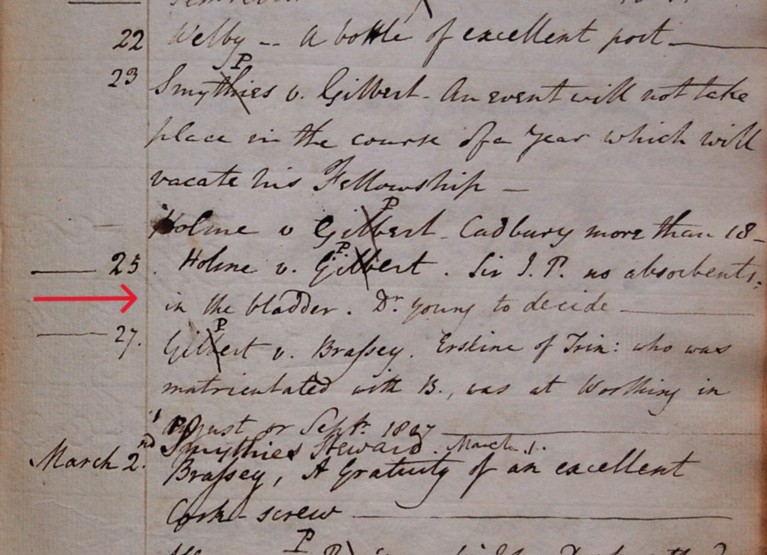
Y is for…Young
Many biographies of Emmanuel’s most celebrated member, the polymath Thomas Young, contain minor inaccuracies about his residence in Cambridge. Young was already a qualified physician when he was admitted to Emmanuel in 1797, but he needed to spend at least two more consecutive years at a university in order to gain admission to the Royal College of Physicians. This, and Young’s declaration that he intended to stay the minimum amount of time at Cambridge, have led some authors to believe that he resided for only two years. Young himself later noted, however, that he stayed for three, and in fact he remained on the college books until December 1802, to satisfy the University’s M.B. requirements. Another statement sometimes encountered is that Young did not come into residence until October 1797, seven months after his formal admission on 18 March. The Parlour wager books show, however, that he was certainly in college on 28 March, and the student account registers indicate that he resided for at least part of Easter Term 1797. This is important, because it confirms that Young’s famous introduction to the Fellows by the Master, as a ‘pupil qualified to read lectures to his tutors’, can confidently be attributed to Richard Farmer, rather than his successor, as has been suggested (Dr Farmer, a long-time friend and supporter of Young, died in September 1797). On 22 February 1800, just before he went out of residence, Young presented the Parlour with a parting gift of seven bottles of old Port, but that was not to be his final evening at Emmanuel. In February 1808, as recorded in the wager book, Young was asked to decide the winner of a bet concerning Sir Isaac Pennington, Regius Professor of Physic at Cambridge. The entry (pictured) refers to him as ‘Dr Young’, because the great man was in town to receive his M.D.
Amanda Goode, College Archivist
8 June 2026
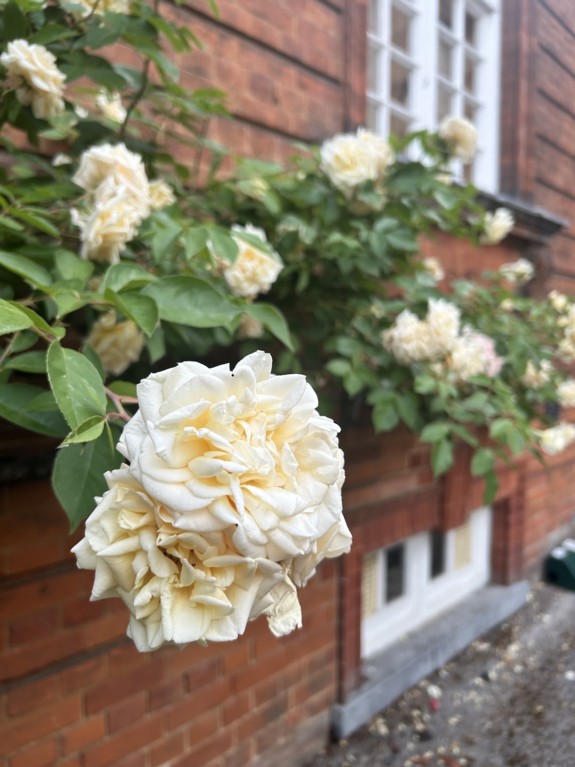
June has brought a welcome change in fortunes for the College gardens after what felt like an exceptionally long spell of hot, dry weather. Throughout much of late spring and into early summer, the gardens experienced prolonged periods without significant rainfall. While the sunshine was enjoyed by many, the dry conditions placed increasing pressure on lawns, borders and newly planted areas, with the grass beginning to lose much of its usual vibrancy and colour.
Thankfully, the weather pattern eventually shifted, and the past week has delivered a succession of heavy showers along with some much-needed, steady rainfall. The difference has been remarkable. Across the College grounds, the lawns are already responding, with fresh green tones returning as soil moisture levels recover. It is always encouraging to see how quickly the landscape can revive when given the right conditions.
The rainfall also arrived at an ideal time for our lawn care programme. We had recently applied an organic fertiliser to the lawns, a treatment that relies on moisture to wash the nutrients into the root zone where they can be most effectively utilised. The recent rain has done exactly that, helping the fertiliser begin its work naturally and reducing the need for supplementary irrigation. Over the coming weeks we expect to see stronger growth, improved colour and greater resilience across the turf areas.
Elsewhere in the gardens, the combination of warmth and moisture has accelerated growth considerably. Herbaceous borders are beginning to reach their peak, summer bedding displays are establishing well, and the trees and shrubs continue to put on strong seasonal growth. As always, regular maintenance remains essential at this time of year, with weeding, pruning and mowing keeping the gardens looking their best for Fellows, students, staff and visitors alike.
As we move further into summer, we hope for a more balanced mix of sunshine and rainfall. The recent showers have provided a valuable boost, and the gardens are already looking healthier and more colourful as a result.

This month we are also delighted to welcome Matilda Downs to the Gardens Department. Matilda joins us as Emmanuel College's Garden Apprentice for 2026–2027 and will be with us for the next 20 months. As part of the Cambridge Colleges Apprenticeship Scheme, she will combine practical, hands-on training in the College gardens with one day each week of formal study at King's College Cambridge.
Apprenticeships play an important role in the future of horticulture and the wider gardening profession. They provide an opportunity for aspiring gardeners to gain practical experience while studying towards recognised qualifications, developing both technical knowledge and workplace skills. For employers, apprenticeships help to nurture the next generation of horticultural professionals, ensuring that valuable skills, expertise and traditions are passed on. They also bring fresh perspectives, enthusiasm and new ideas into the workplace.
At a time when the horticultural industry continues to face skills shortages, apprenticeship schemes offer an invaluable pathway into the profession and help secure the future of gardens such as our own. We look forward to supporting Matilda throughout her apprenticeship and helping her develop her skills and experience over the coming months.


Supporting the development of the next generation of horticulturists extends beyond Emmanuel College itself. Last month, I was delighted to serve as a judge at the Grand Final of the Chartered Institute of Horticulture's Young Horticulturist of the Year competition. This year's final was held in Rochdale, within the magnificent Gothic surroundings of Rochdale Town Hall, providing a fitting venue for one of the profession's most prestigious competitions for emerging talent.
The competition showcases some of the brightest young minds in horticulture, and it is always inspiring to see the enthusiasm, knowledge and dedication demonstrated by the finalists. I feel immensely proud to play a small part in supporting the development of young people within our profession, both at a national level through initiatives such as the Young Horticulturist of the Year competition and locally through opportunities such as our apprenticeship programme here at Emmanuel.
The Chartered Institute of Horticulture plays a vital role in promoting professionalism and excellence across the industry. My involvement with the Institute provides valuable opportunities to engage with and learn from some of the country's leading horticulturists, exchanging ideas, experiences and best practice. These professional networks are enormously beneficial, providing support, inspiration and confidence that I can bring back to my role as Head of Gardens and Landscapes at Emmanuel.
The knowledge and connections gained through these professional relationships ultimately benefit the entire Gardens Department. They help us maintain high standards, stay informed about developments within the industry and, importantly, provide the best possible support and guidance for colleagues and apprentices as they develop their own careers in horticulture.
Professional development remains an important part of life within the Gardens Department, and this month Sally MacKenna spent three days at the renowned Beth Chatto Gardens undertaking specialist training in plant propagation. The course provided an excellent opportunity to develop new skills, refresh existing knowledge and learn different approaches to propagation techniques from experienced horticultural professionals.
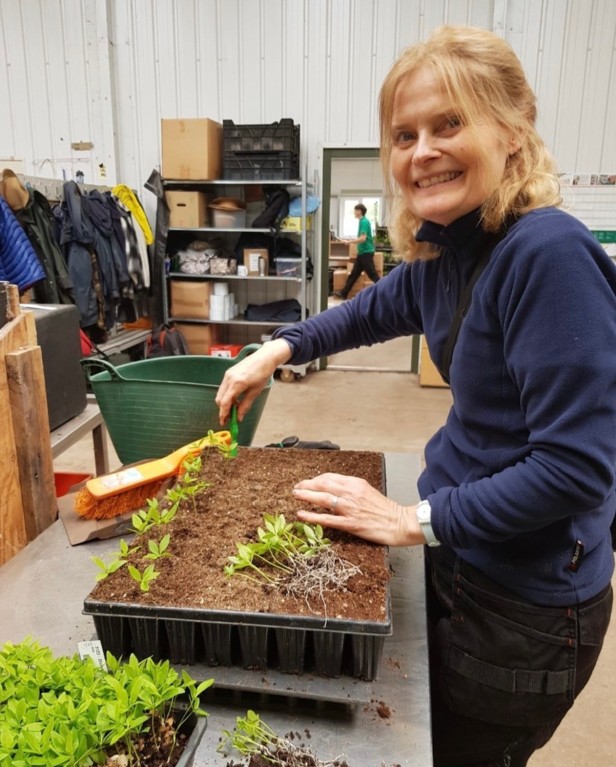
One of the great benefits of continuing professional development is that the knowledge gained does not remain with just one individual. The skills and techniques Sally has learnt can be brought back to Emmanuel and shared across the team, helping to broaden our collective understanding and encouraging discussion about different methods and approaches. In this way, investment in one team member benefits the whole department and ultimately the gardens themselves.
As Head of Gardens and Landscapes, I strongly encourage all members of the team to continue learning, regardless of where they are in their careers. Horticulture is a profession in which learning never truly ends. New research, changing environmental conditions, evolving cultivation techniques and the sheer diversity of plants mean there is always something new to discover. Whether someone is at the beginning of their horticultural journey or has decades of experience, there is always value in developing new skills and expanding existing knowledge.
By embracing opportunities for training and professional development, we ensure that the Gardens Department continues to evolve, maintaining the highest standards of horticulture while bringing fresh ideas and best practice into the management of Emmanuel's beautiful gardens and landscapes.
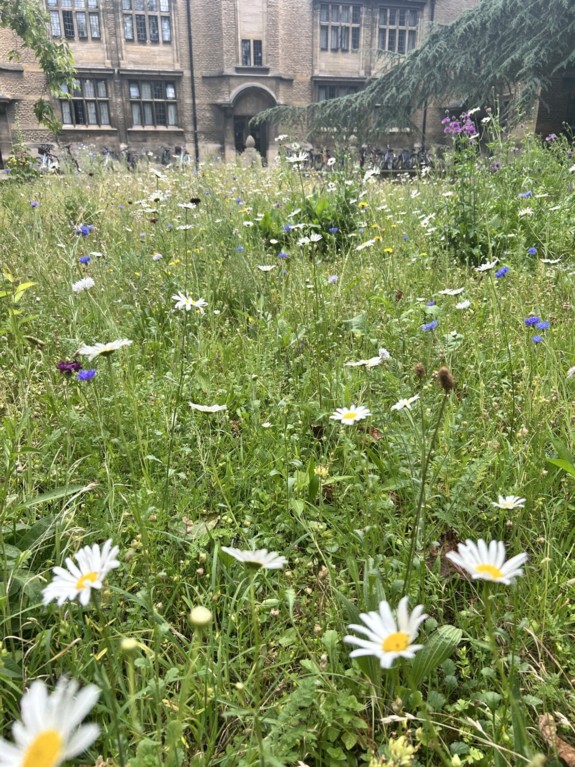
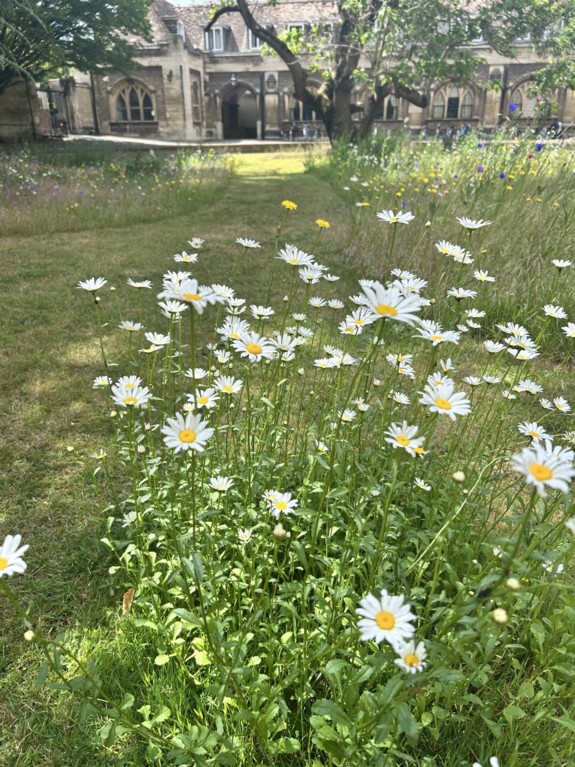
June is also a transitional month in the gardens. Much of the excitement of spring has now passed, with the bulb displays fading and the meadows completing their peak flowering period. While these seasonal highlights are coming to an end, attention now turns towards the grandeur and majesty of the summer borders, which are beginning to build towards their finest display of the year.
This period requires a degree of patience from both gardeners and visitors alike. As tempting as it can be to tidy everything away immediately, much of the spring foliage still has an important job to do. The leaves of daffodils, tulips and other spring bulbs must be allowed to die back naturally before they are removed. Although this can sometimes create a slightly untidy appearance, it is an essential part of the plant's lifecycle.
The fading foliage continues to photosynthesise, capturing sunlight and converting it into energy which is stored within the bulb. These reserves provide the resources needed to produce healthy growth and flowering displays next spring. By allowing the foliage to mature fully before cutting it back, we help ensure that next year's display is every bit as impressive as this year's.
Gardening often teaches the value of patience, and nowhere is that more evident than during June, when we balance the remnants of spring with anticipation for the spectacular summer displays still to come.
.jpg)
13 May 2026

Plate 1. Giovanni Belzoni, 'Narrative': 'From the Tombs of the Kings at Thebes'.
Archaeology is a wonderful subject for television – the suspense of the search, the astonishing reveal – and the wide public interest this now arouses has promoted careers for various celebrity archaeologists. Among Emmanuel’s collection of illustrated books is one recording the work of an early celebrity archaeologist: Giovanni Battista Belzoni’s Narrative of the Operations and Recent Discoveries within the Pyramids, Temples, Tombs and Excavations in Egypt and Nubia (1821).
Belzoni’s CV, however, was somewhat more eclectic than your average academic TV archaeologist, and he is believed to be among the inspirations for Indiana Jones, the intrepid archaeologist hero in the Spielberg films. Born into a poor barber’s family in Padua he was initially a barber before – after an unhappy teenage love affair – entering a Capuchin monastery as a would-be monk, while simultaneously studying hydraulic engineering. When Napoleon invaded Italy Belzoni fled abroad, arriving in London in 1803 where he became a British subject, married, and launched a new career as a circus strongman. At six feet seven inches tall and under the stage name of ‘The Patagonian Samson’ he wowed audiences at Sadler’s Wells, lifting and carrying round the stage an iron frame on which twelve men sat. His wife – reportedly a matchingly substantial figure – took part in performances. After touring his strongman act to Portugal, Spain, Sicily and Malta, Belzoni turned up in Egypt, unsuccessfully petitioning the Pasha, Muhammad Ali, for employment as a hydraulic engineer.
But with funds from the British Consul, Sir Henry Salt, Belzoni set off in 1816 to explore the possibility of moving to Britain a colossal carved head that lay half buried in the desert sands.
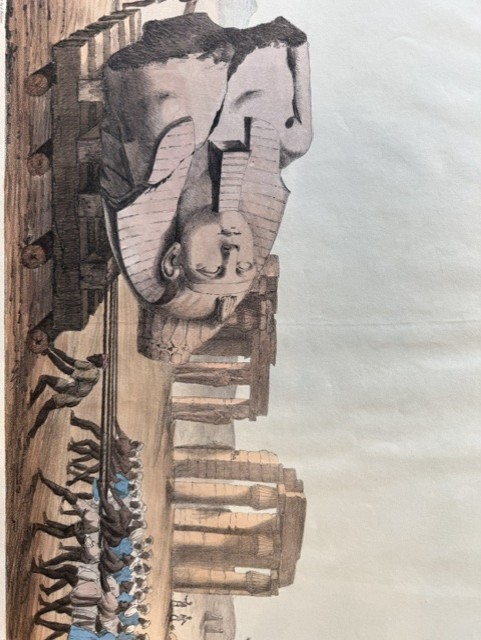
Plate 2. 'Mode in which the Young Memnon's Head ... was removed by G. Belzoni'.
This head of Ramesses II, often called the Younger Memnon, weighed over seven tons. It took 130 men seventeen days to move it on rollers a short distance to the Nile, ready to be shipped to London, where it remains in the British Museum and was the inspiration for Shelley’s poem ‘Ozymandias’.
Belzoni then proceeded to the temples at Abu Simbel, where only the tops of the four 20-metre-high statues of Ramesses II were still visible above the drifted sands.
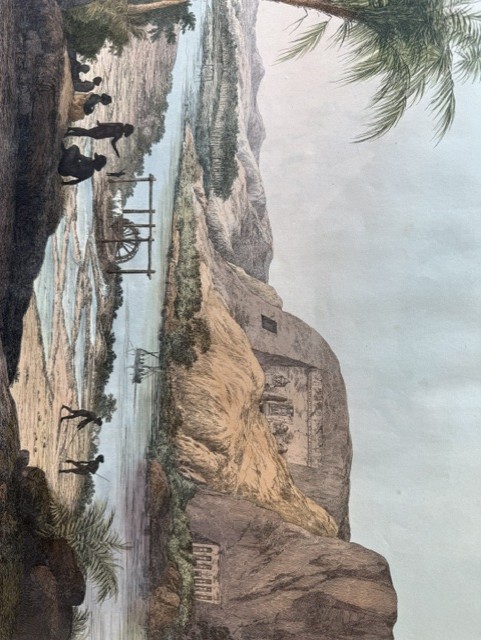
Plate 3. 'Exterior View of the Two Temples at Abu Simbel'. (Temples just visible on the far bank).
Unable to enter the temples Belzoni proceeded to Philae.
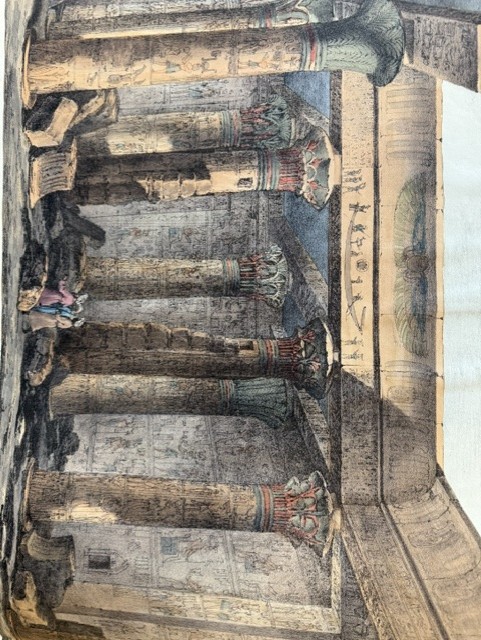
Plate 4. 'Interior of the Temple in the Isle of Philae'.
Belzoni also excavated at Karnak in Luxor.
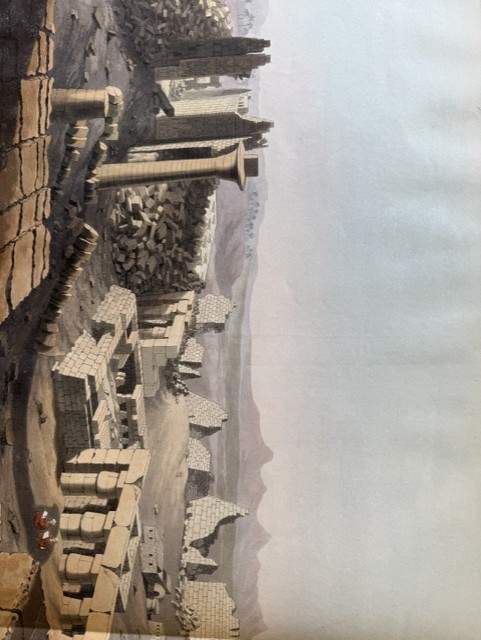
Plate 5. 'General View of the Ruins of the Great Temple at Karnak'.
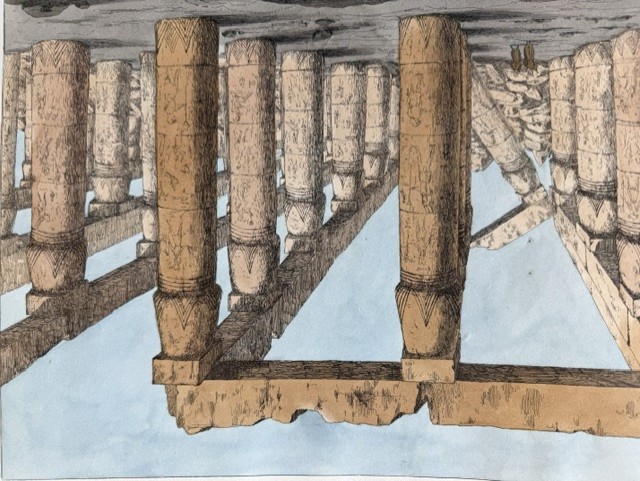
Plate 6. 'The Temple at Karnak'.
It was at Karnak that Belzoni discovered the red granite sarcophagus of Ramesses III – the carved lid is now in the Fitzwilliam Museum, which also holds a striking portrait of Belzoni in Middle Eastern garb. Later, Belzoni succeeded in uncovering the façade and entering the Abu Simbel Great Temple, long looted but with splendid decorations.
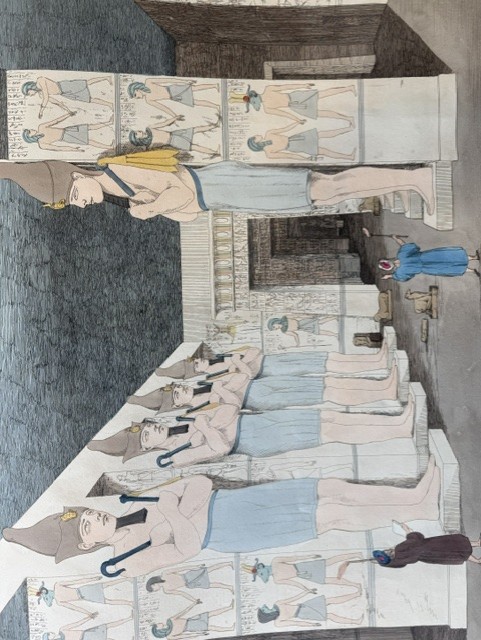
Plate 7. 'Interior of the Temple at Abu Simbel in Nubia'.
In the Valley of the Kings in 1817 Belzoni discovered the intact tomb of Seti I, father of Ramesses II, with its remarkable bas-reliefs and frescoes. (The sarcophagus is now in the Sir John Soane Museum). After returning to Cairo and borrowing the necessary funding, Belzoni then discovered the entrance to the second tallest pyramid at Giza, the Pyramid of Khafre.
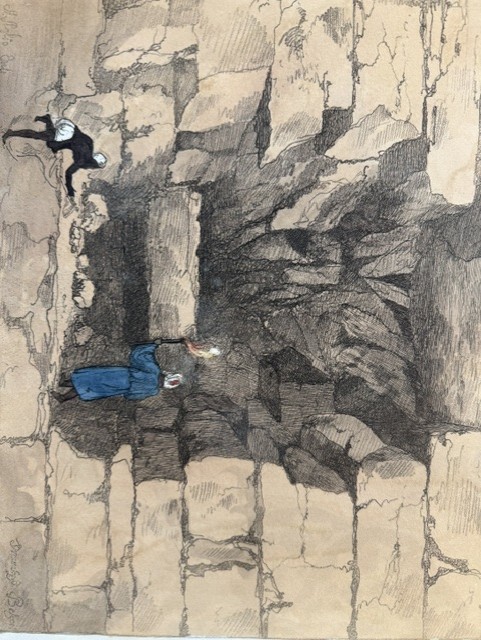
Plate 8. 'Forced Passage into the Second Pyramid of Giza, discovered by G. Belzoni'.
Other excavations took place at Kom Ombo and at Erment.
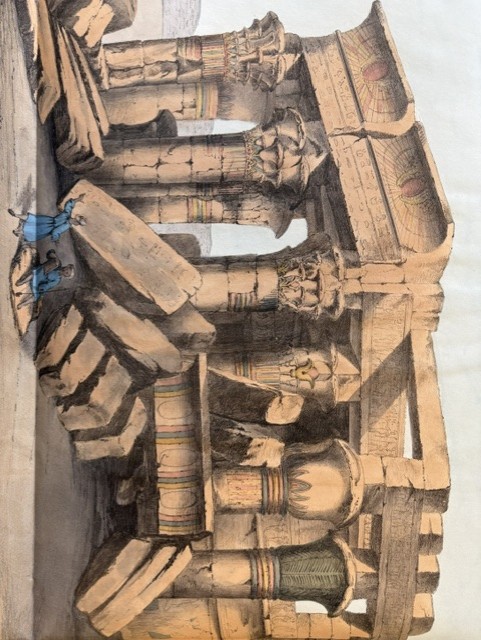
Plate 9. 'Ruins of Kom Ombo'.
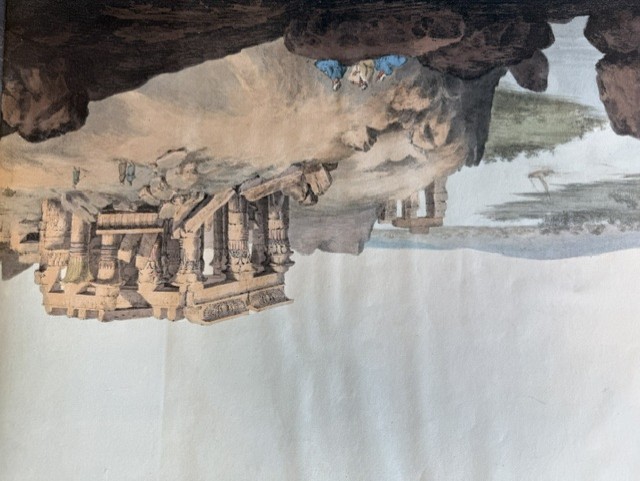
Plate 10. 'Ruins of Kom Ombo and Adjacent Country, Drawn from Nature by G. Belzoni'.
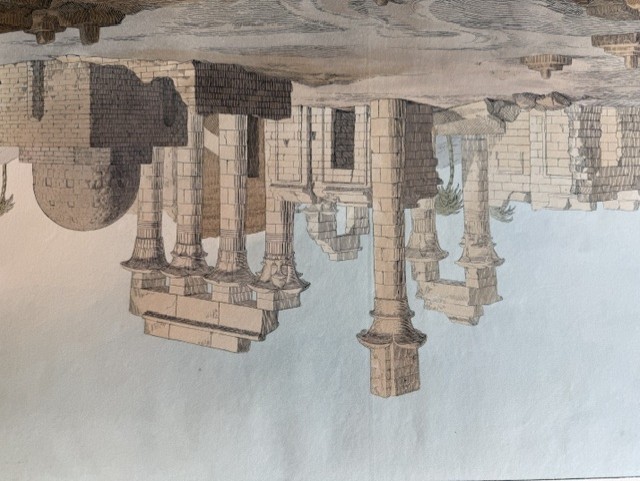
Plate 11. 'Temple at Erment'.
However, subsequent excavations in Thebes were blocked, because Salt had purchased sole rights to excavate, so excluding Belzoni (who in his dealings with the British establishment often felt slighted for not being ‘a gentleman’). Nothing daunted, Belzoni instead crossed deserts to locate the fabled ancient port city of Berenice on the Red Sea.

Plate 12. 'Temple on the Road to Berenice on the Red Sea'.
Returning to London in 1820, Belzoni hired the Egyptian Hall in Picadilly to exhibit his reconstruction of the tomb of Seti, and published his Narrative, with a separate volume of plates etched after drawings by Belzoni. Many of the plates were printed by lithography, making Belzoni’s the first significant publication produced by this new technology. The vividly-coloured illustrations of tomb and temple decorations fuelled the contemporary craze for the Egyptian taste.

Plate 13. 'From the Tombs of the Kings at Thebes'.

Plate 14. 'From the Tombs of the Kings at Thebes'.
In 1823 Belzoni set off on an expedition to discover the source of the Niger and to visit Timbuktu. But like the earlier Scottish explorer Mungo Park, who pursued the same quest, Belzoni succumbed to illness and died at a location now in modern Nigeria. Belzoni’s methods can give modern archaeologists the shudders, but Howard Carter, the discoverer of the Tutankhamun tomb, praised him generously as the pioneer that he was.
Barry Windeatt (Keeper of Rare Books)
11 May 2026
Emmanuel College Gardens
April brought with it an unusually prolonged spell of dry weather, something that has become an increasingly familiar feature of recent springs in Cambridge. While the clear skies and warm sunshine were welcome after the winter months, the lack of rainfall quickly began to show across the gardens. Newly planted areas and spring bedding required careful attention, with watering routines becoming an essential part of the daily schedule much earlier than we would normally expect.
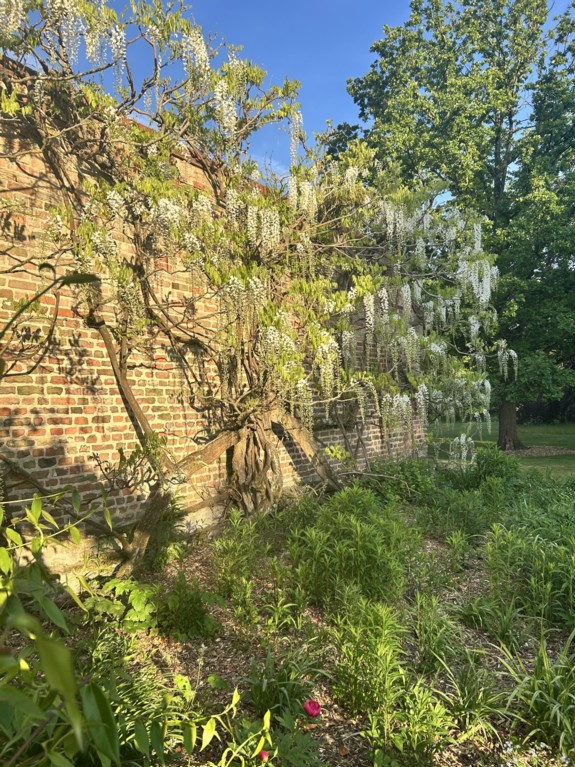
The dry conditions have, however, encouraged some plants to flourish spectacularly. The wisteria performed particularly well this year, with long cascades of violet flowers hanging heavily around the courts and garden walls. Tulips also enjoyed the bright conditions, producing vivid displays across the Fellows’ Garden and the borders around Front Court. The magnolias gave a notably long flowering season before the warmer temperatures accelerated the transition into early summer growth.

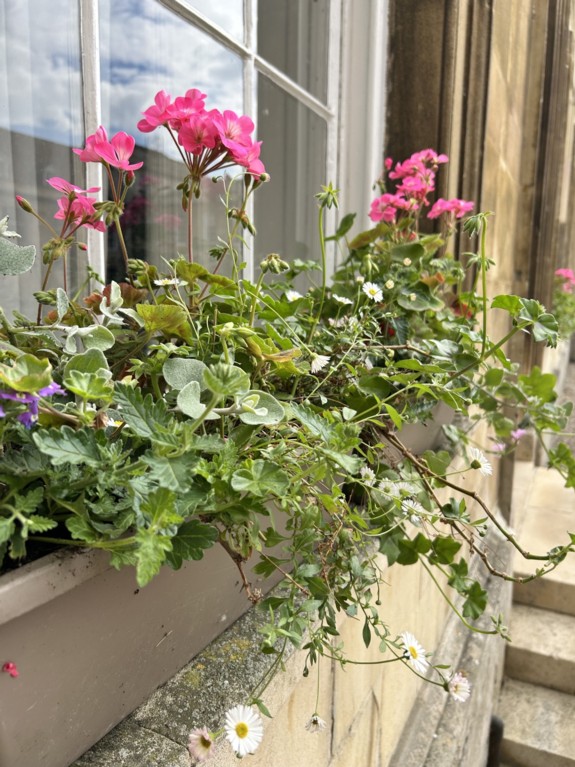
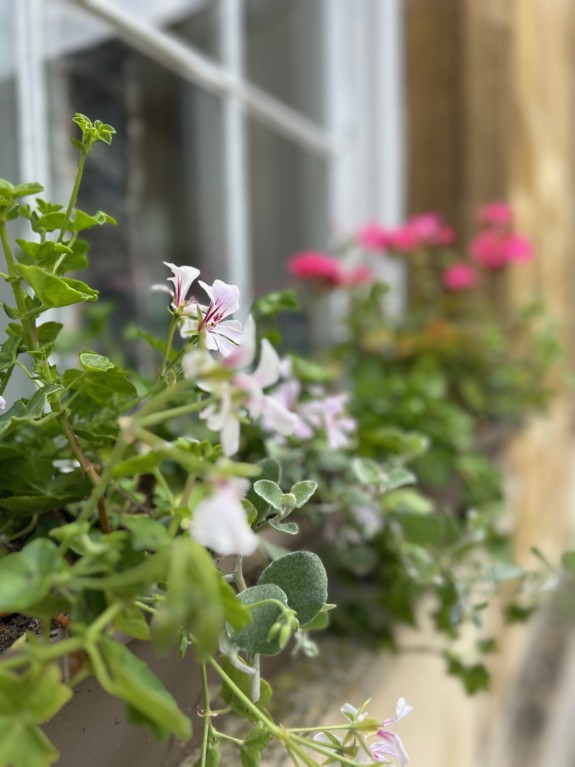
One particularly welcome return this season has been the reappearance of the window boxes in Front Court, bringing an additional layer of colour and softness to the historic architecture of the College. Planted in a vibrant summer palette, the displays include F1 pink geraniums, mini trailing petunias, trailing verbena, and trailing ivy-leaf geraniums, complemented by the silver foliage of Helichrysum petiolaris. Accents of blue from Felicia amelloides and the warm tones of Calibrachoa ‘Rosy Maple’ help create a long-lasting display designed to thrive throughout the summer months. In the bright early May sunshine, the boxes have already begun to establish well and are proving a cheerful focal point for all entering the College.
Lawns across the College have needed thoughtful management. Although Emmanuel’s established grass areas remain resilient, April’s rainfall total was significantly below average, and signs of stress began appearing by the end of the month. Rather than pursuing excessively lush growth, our approach increasingly focuses on maintaining healthy, durable turf that can better tolerate these changing seasonal patterns. Areas left slightly longer are already proving more resilient and continue to support pollinating insects and other wildlife.
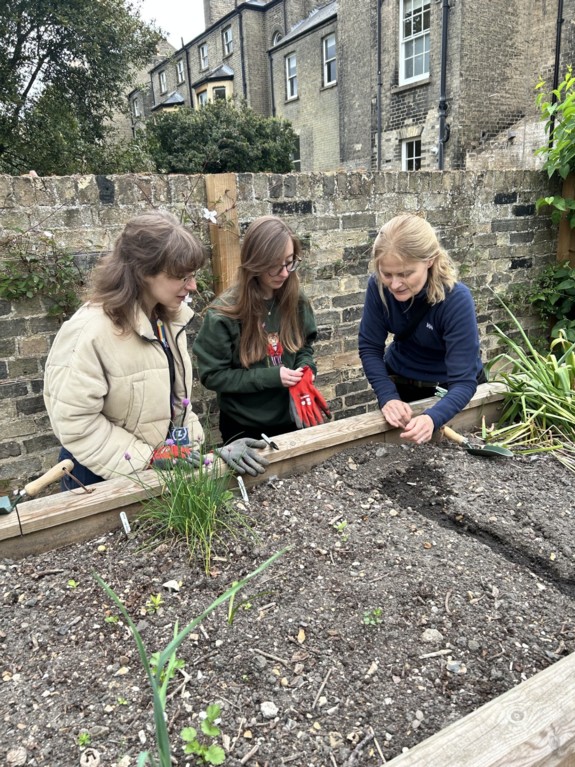
The community kitchen gardens and cutting gardens have also benefited from the warm soil temperatures. Sweet peas, herbs, and strawberries and Rhubarb are developing rapidly, along with the gooseberries we are hopeful for strong summer displays over the coming weeks. Early irrigation has been essential, particularly for younger plants whose root systems are not yet fully established. Mulching has again played an important role in conserving moisture and improving soil condition throughout the ornamental borders. The department welcomed students via another gardener’s workshop, held on 7th May.
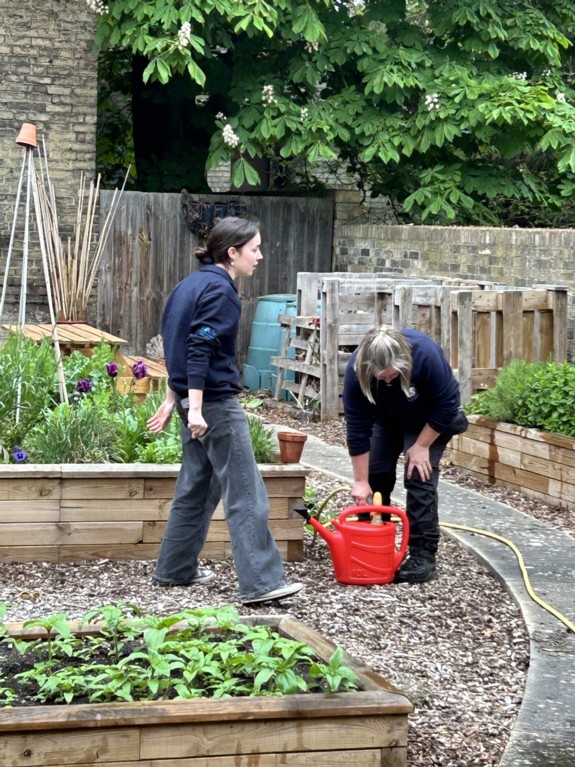
One of the pleasures of this time of year is watching the gardens change almost daily. May and June bring a remarkable sense of momentum: fresh foliage deepens in colour, herbaceous borders begin to fill out, and the long evenings allow both gardeners and visitors to enjoy the spaces in a different way. The scent from roses is beginning to drift across the courts, while the lime trees will soon provide their familiar canopy and shade as we move fully into summer.
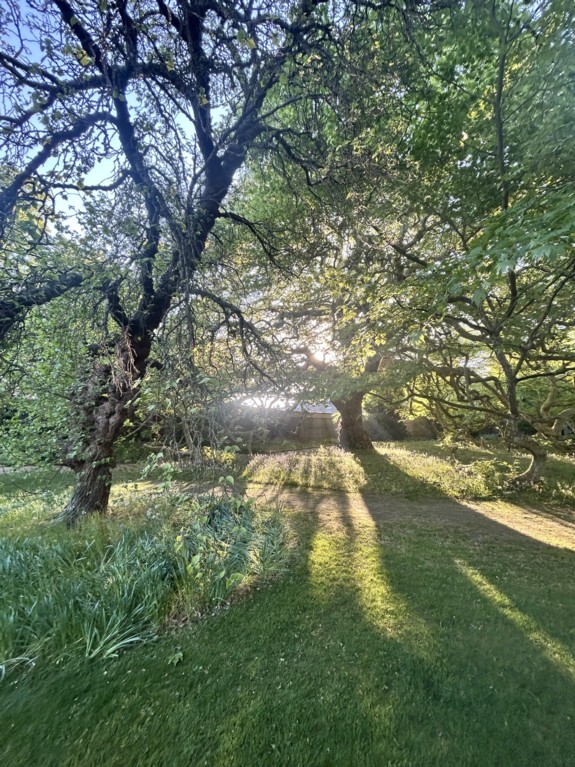
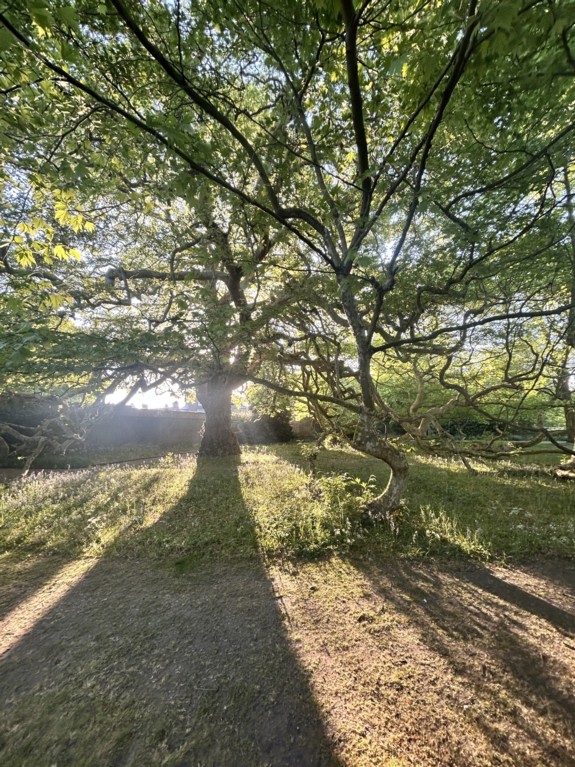
Behind the scenes, the gardening team continues its seasonal programme of staking, pruning, feeding, and propagation. Irrigation planning has become a more significant part of our work in recent years, and the increasingly dry spring periods remind us of the importance of sustainable water management within historic gardens such as these.
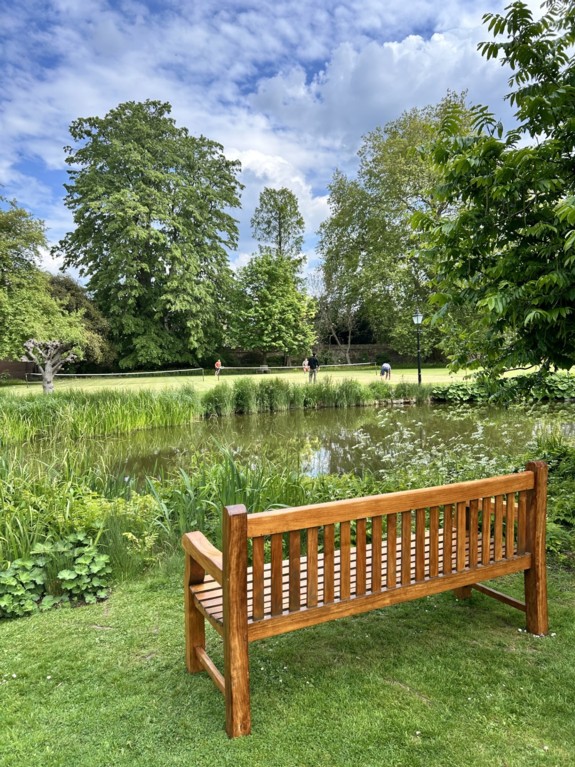
Despite the challenges posed by the dry weather, the gardens remain full of colour and activity, and it is encouraging to see students, fellows, staff, and visitors making the most of the outdoor spaces during the Easter Term. As always, the changing seasons bring both challenges and rewards, and we look forward to seeing the gardens continue to evolve over the summer months.
It is around this time of year that the College quietens down as the students enter the quiet period. For many it is a time for deep concentration as exams are almost here. This is also the time that I remind you all to take advantage of the gardens. If you can, take a break, walk around the gardens, clear your head a little. The warmer weather might be perfect for quiet study in the grounds. Remember, if you are feeling a little stressed or overwhelmed, then it is fine to come a have a brief chat with the gardeners. The gardens are proven to help with wellbeing, and the gardeners may well pass on some wisdom to help you relax.
In other news, I have had a slight change to my job title. My role is now Head of Gardens and Landscapes, and this reflects the changes in my everyday working schedule, overlooking the colleges landscaped areas both here at main site, plus the sportsground’s landscapes, and also the many off-site properties and hostels. I think for the purposes of this regular blog, we will continue to call it a Head Gardeners Report so not to add any confusion.
Brendon Sims - Head of Gardens and Landscapes
8 May 2026
X is for…XII Club
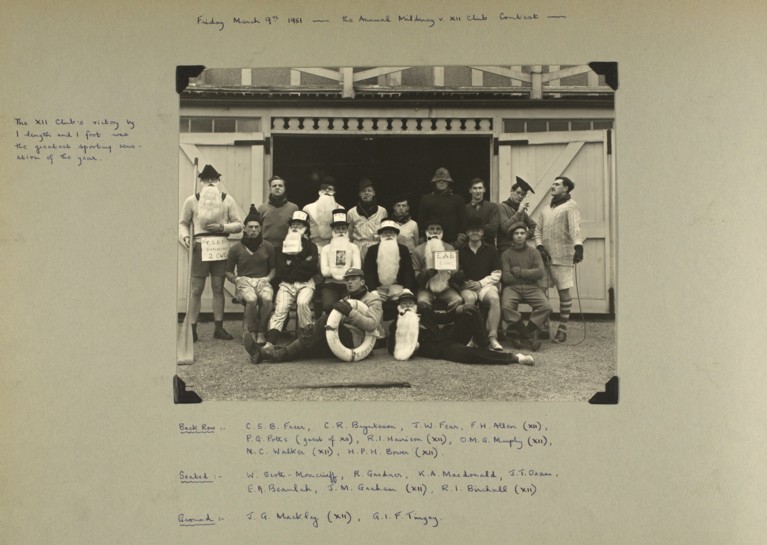
The most exclusive student clubs are, by definition, those with a limited membership, and the use of Roman numerals in their names adds an extra touch of class. Emmanuel had several such societies, the longest-lived of which was the XII Club. The Lent Term 1890 college magazine informed readers that ‘A literary society [had] been started among the first year men…at present it consists of twelve members, though it is not limited strictly to this number’. The club’s activities were originally twofold: firstly, to read classical plays aloud and secondly, to discuss essays written by club members. After a few years, though, its members decided to leave essay-writing to the Mildmay Club. The two societies continued to enjoy a friendly rivalry, however, competing against each other in an annual fancy-dress boat race (the caption to the 1951 photo reproduced above declares that the XII Club’s victory represented ‘the greatest sporting sensation of the year’). Perhaps motivated by brief flares of egalitarianism, one or two of the XII Club’s early magazine reports render its name as ‘Twelve’, but the use of Roman numerals always prevailed. The club lapsed during the Second World War but was re-founded in 1946 at the prompting of two college Fellows. The new members continued the club’s tradition of ‘reading plays and drinking beer – and coffee’. Edward Welbourne, Senior Tutor and later Master, dismissed the new incarnation as a bunch of ‘college toughs’! The XII Club’s upbeat report in the 1967-68 college Magazine declared that it had ‘flourished’ that year, having ‘profit[ed] greatly from the conversation, inhibition, lack of inhibition, and insanity of its new members’ (and, one suspects, the regular presence of guests from the women’s colleges). It is surprising, then, that the club appears to have become defunct almost immediately afterwards.
X is for… X-ray Crystallography
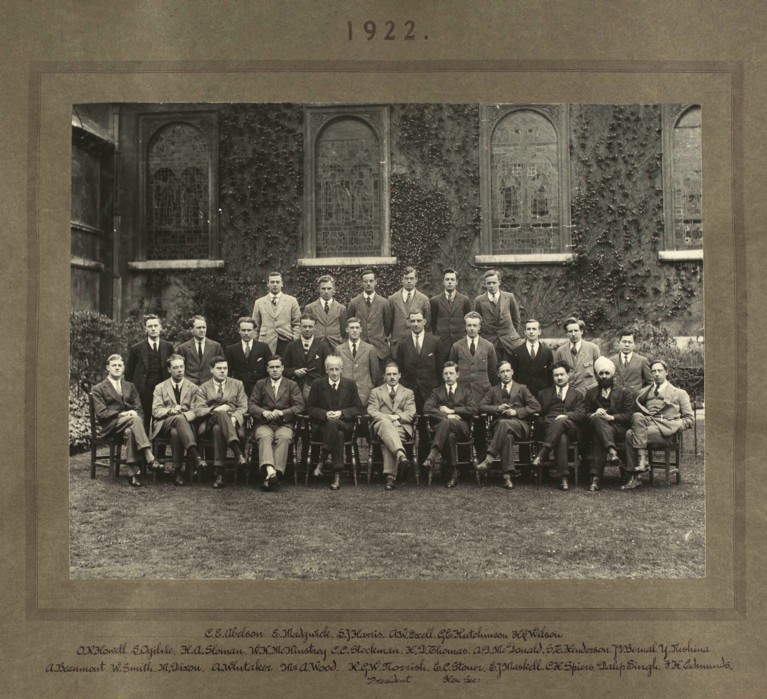
This discipline, involving the study of the atomic and molecular structure of crystals, has advanced tremendously in the last century. A pioneer in the field was John Desmond (‘Des’) Bernal, admitted to Emmanuel in 1919. Bernal (standing 2nd from the right, middle row, in this 1922 Emmanuel Natural Science Club photo) graduated with a First and went on to achieve international recognition for his achievements in the development and application of X-ray crystallography. According to his obituary in the 1971 college magazine, he was ‘an intellectual Marxist, fierce in argument but always gentle in manner, not a militant revolutionary’. All the same, Bernal’s robust support of Stalinism undoubtedly prevented him from receiving some of the honours that were his due. Abandoning pacifism in 1939, he made valuable scientific contributions to the war effort. In 1965 Emmanuel made him an Honorary Fellow, and in his letter of thanks Professor Bernal replied that he remembered the college ‘with the greatest affection and realise now what I owe to my training there’. X-ray crystallography was also the specialism of another remarkable Emmanuel man, David Elias. Admitted in 1938, he is thought to have been the first severely deaf student to be awarded a PhD. Elias later recalled that Cambridge’s supervision system was ‘almost as good as individual coaching’. He attended lectures ‘in the hope of getting something from the demonstrations by the lecturer and from the blackboard’ and sat next to friends ‘who let me copy their notes’. His interest in crystallography was formed at this time. After graduating in 1941, Elias worked as a technician at the Royal Ordnance Factory. Once the war was over, he enrolled as a research student at Leeds University, his doctoral thesis being entitled ‘An X-ray crystallographic study of trinitroethane’. Dr Elias later worked in the field of industrial research.
Amanda Goode, College Archivist
16 April 2026

Plate 1. 'Leander's Vision', from 'Hero and Leander' (by Christopher Marlowe, completed by George Chapman; edition illustrated by Lettice Sandford; The Golden Hours Press, 1933).
Emmanuel is fortunate to have – on long loan from the late Mr Charles Nugent and his family – a comprehensive collection of the published works of Lettice Sandford (1902-1993), who worked as a gifted wood-engraver in the 1930s and 1940s.
Lettice Sandford (nee Rate) grew up in comfortable circumstances at Milton Court, a seventeenth-century house on the outskirts of Dorking that had been substantially reworked by the Victorian architect William Burges for Lettice’s father, a wealthy lawyer, banker and philanthropist – the house survives as the offices of a health insurance company. Lettice studied at the Byam Shaw and Vivat Cole School of Art and then studied book illustration at the Chelsea Polytechnic, where she was taught etching by Graham Sutherland. In 1929 she married Christopher Sandford, a book designer from an Anglo-Irish background who would become a founding director of the Folio Society.
Together they started the Boar’s Head Press in Devon, a private press that published some of Lettice’s early wood-engraving work, starting in 1932 with her illustrations for an edition and translation of the poems of the Ancient Greek poetess, Sappho of Lesbos.

Plate 2. 'Sappho,' illustrated by Lettice Sandford (Boar's Head Press, 1932): 'The moon has set, and the Pleiades; it is midnight, the time is going by, and I lie alone'.

Plate 3. 'Sappho': 'Evening, that bringest all that bright morning scattered, then bringest the sheep, the goat and, back to its mother, the child ...'

Plate 4. 'Sappho': 'But thou shalt ever lie dead, nor shall there be any remembrance of thee then or ever ... but thou shalt wander unnoticed ... flitting among the shadowy dead ... '
Here she established her trademark deployment of very fine white lines incised into black, or vice versa, in images of exceptional fineness of detail. This is on display in her illustrations for the Boar’s Head edition of Thalamos (1932), ‘or The Brydall Boure, being the Epithalamion and Prothalamion of Edmund Spenser’.

Plate 5. Frontispiece to 'Thalamos' (Boar's Head Press, 1932).
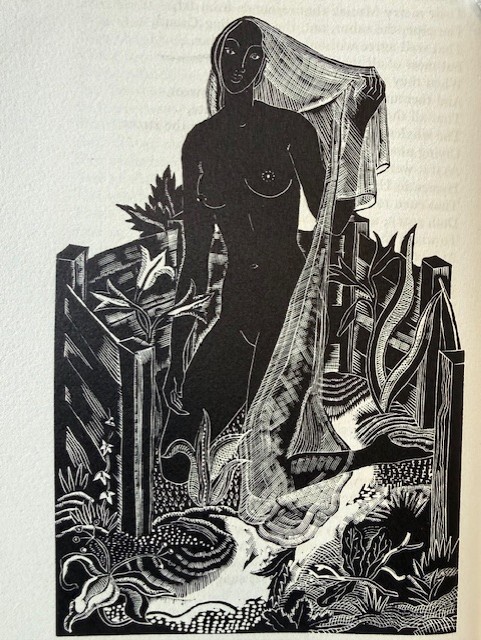
Plate 6. 'Thalomos': 'Tell me, ye merchants' daughters, did ye see / So faire a creature in your towne before?'
Also in 1932 the Boar’s Head Press published The Virgin by Marius Lyle, a kind of fictive alternative history of the Virgin Mary, for which Lettice provided a bold frontispiece illustration.

Plate 7. Frontispiece to Marius Lyle, 'The Virgin' (Boar's Head Press, 1932).
Her Sappho and Virgin Mary show the beginnings of an identification with exceptional women that seems to run through Sandford’s work, and which is again to be seen in her striking engraving for Salome before the Head of St John (1933), a poem by N. Morland and Peggy Barwell, published by the Boar’s Head as a pamphlet. The looming figure of Salome, fixating on the saint’s severed head, dominates the composition, with its juxtaposed subsidiary images including Salome’s frenzied dance and Christ as the Man of Sorrows.

Plate 8. 'Salome before the Head of St John' (Boar's Head Press, 1933).
In 1933 Lettice provided a striking two-page frontispiece for a Boar’s Head edition of Dreams and Life by Gerard de Nerval: ‘an attempt by a poet and a genius, suffering from intermittent periods of insanity, to describe his sensations during those periods’.

Plate 9. Frontispiece to Gerard de Nerval, 'Death and Life' (Boar's Head Press, 1933).
In the same productive year Lettice designed the illustrations for a Boar’s Head edition of Christopher Marlowe’s poem Hero and Leander, with a compelling frontispiece and images of the drowning Leander.

Plate 10. Frontispiece to 'Hero and Leander' (1933).

Plate 11. 'Hero and Leander': Leander sinks down in the sea.
The volume also illustrates Marlowe’s poem The Passionate Shepherd to His Love.

Plate 12. Christopher Marlowe, 'The Passionate Shepherd to his Love' (illustrated by Sandford along with 'Hero and Leander'): 'Come live with me and be my love'.
Some of these Boar’s Head editions were issued in bindings that are themselves works of art and things of beauty.
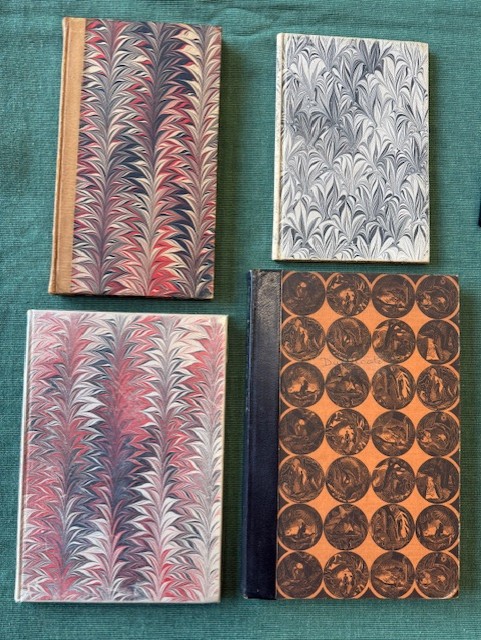
Plate 13. Some bindings, The Boar's Head Press editions.
Meanwhile in 1933 Christopher Sandford became the proprietor of the distinguished private press, The Golden Cockerel Press, and so Lettice began to publish her work with that press, beginning with a translation of Cupid and Psyche (1934).
The theme of unconventional women returns in Lettice’s engraved illustrations for the Golden Cockerel edition of The Golden Book of Kydno (1935). This is presented as the English translation from Modern Greek of a work of Lesbian literature from around 1900. Lettice’s illustrations no doubt seemed rather naughtier in 1935. By now, Matisse is an influence.
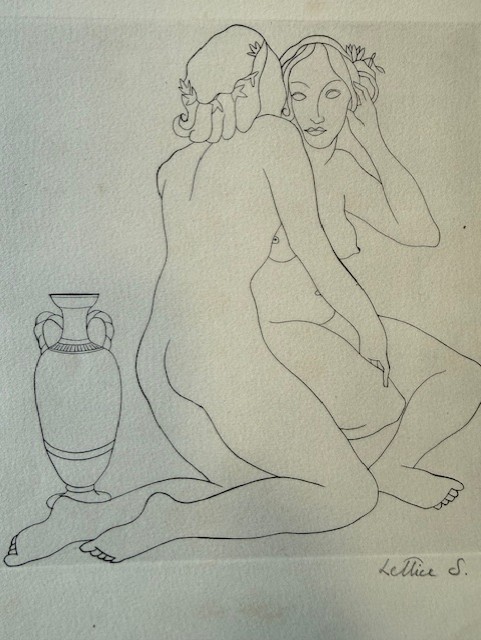
Plate 14. 'The Golden Book of Kydno', supposedly 'translated from the Modern Greek of Evadne Lascaris'; illustrated by Lettice Sandford (Golden Cockerel Press, 1935): 'Had dead and eternal Sappho seen you as I have seen, pale Palmyra, bathed in the green moonlight of the sea, no fire would have dared to burn the song born there like Venus'.
The following year the Golden Cockerel Press brought out an ambitious edition in a large format of the Old Testament book, The Song of Songs (1935). Lettice’s engravings illustrate a facing page of biblical text in splendid typography.

Plate 15. 'The Song of Songs', illustrated by Lettice Sandford (Golden Cockerel Press, 1936): illustration to the verses beginning 'I am black but comely, O ye daughters of Jerusalem' and ending 'A bundle of myrrh is my well-beloved unto me; he shall lie all night betwixt my breasts'.
On one level, the Song of Songs is a Hebrew erotic poem, and it is perhaps not altogether surprising that Golden Cockerel subscribers could also purchase extra sets of the engravings to the Golden Book and the Song of Songs as loose copies each signed by the artist, and these came in a discreet sleeve.
Lettice Sandford continued to illustrate books for the Golden Cockerel and other presses until 1953. But for the next four decades of her long life she turned to other interests, becoming a pioneer in the revival of interest in corn dollies (traditional straw craft items) and moving on to an interest in working in watercolour. The College is lucky to be able to enjoy examples of her wood-engravings during a heyday of British book illustration.
Barry Windeatt (Keeper of Rare Books)

Plate 16. An illustration by Sandford to Christopher Whitfield, 'Lady from Yesterday' (Golden Cockerel Press, 1939): the narrator reflects by a tomb in a country churchyard.
14 April 2026
(2).jpg)
W is for…Walnut and Wolfenden
Before fixed names were given to Emmanuel’s buildings and courts at the end of the nineteenth century, a multiplicity of terms were used, many of them short-lived and/or colloquial. A letter written in 1695 by Thomas Dillingham, an Emmanuel graduate, recalled ‘the entry through which we got from the Quadrangle [Front Court] into Wolfenden’s Court’. James Wolfenden, a college Fellow during Dillingham’s undergraduate days, had evidently resided in the narrow courtyard that once occupied the site of the current southern Front Slips. The term ‘Wolfenden’s Court’ is not found in the college’s own records; indeed, the courtyard was known as ‘Long Court’ for most of the eighteenth century. Front Court, in particular, has been known by a variety of names over the centuries. In 1735, Thomas Wiseman, a handyman frequently employed by the college, presented a bill for painting the ‘posts & Rails [in] the Walnutt Tree Court’. An invoice handily submitted at the same time, by a different contractor, refers to mowing the grass in ‘the great court’ and ‘the Eagle court’. As it is known that Eagle Court was what is now called New Court, the logical deduction must be that ‘Walnutt Tree’ and ‘great court’ refer to the same place, i.e. Front Court. This would indicate that the tree that once grew in the centre of that quadrangle, as depicted in David Loggan’s well-known engraving of the late seventeenth century (pictured), was a walnut. If so, this would (alas) quash the romantic theory that the tree was an oak, planted to celebrate Sir Walter Mildmay’s famous metaphor about the college he had founded. While it is unlikely that another tree will ever be planted in the soil of Front Court, it might be worth noting that walnut trees can be successfully grown in pots…
.JPG)
W is for…Westmorland Building
The elegant Classical range on the south side of Front Court, now known as the Westmorland Building, has had an adventurous history. The original building on the site, erected in the mid-1580s, was known for several centuries as the ‘Founder’s Range’. It was said to have been built to a very high standard, and indeed it appears to be in excellent repair in Loggan’s engravings. Yet in 1718, the college sent out an appeal letter to raise funds for the reconstruction of this allegedly ‘ruinous’ structure. Perhaps ‘unfashionable’ might have been nearer the truth. The replacement building, the shell of which was completed by 1722, was furnished with a swish portico over the central staircase entry, surmounted by a carving of what the stonemason referred to as ‘the Founders Coarte of Armes’. The arms are, in fact, those of the Fane family. In 1599, Francis Fane, 1st Earl of Westmorland, had married the heiress Mary Mildmay, granddaughter of Emmanuel’s founder. Two of their descendants were major contributors to Emmanuel’s 1718 appeal: Thomas Fane, 6th Earl of Westmorland, who gave £500, and his brother John, later 7th Earl. Thomas also provided the architect of the new building, in the person of his own estate manager, John Lumley. The Founder’s Range was gutted by fire in 1811, and the under-insured college was obliged to launch another appeal. One of the chief donors to the repair fund was John Fane, 10th Earl of Westmorland. The range was formally renamed the ‘Westmorland Building’ in the late nineteenth century, as a tribute to the earls’ generosity. The image above shows the 1718 appeal letter (left), a contractor’s 1725 bill for work on the staircases of ‘the New Building’, and a photograph taken in about 1960, showing the building’s formerly soot-blackened façade.
Amanda Goode, College Archivist
13 April 2026
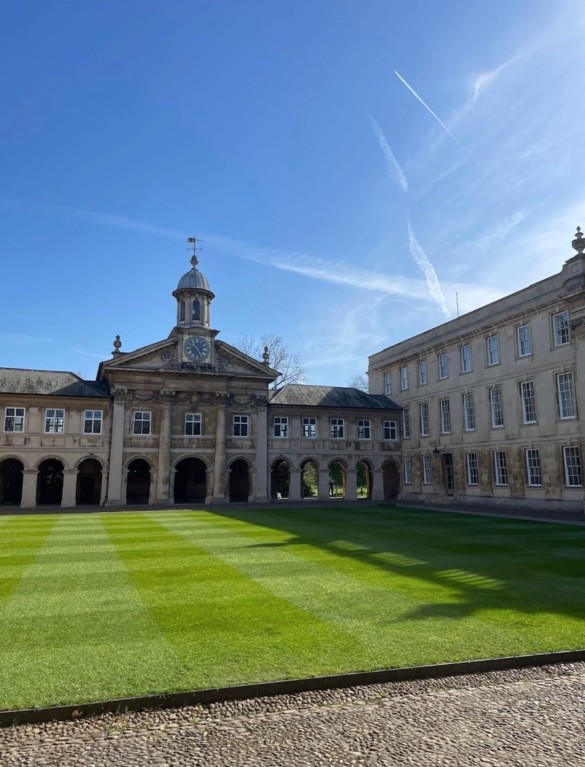
April & May
Spring has a way of transforming the gardens almost overnight. After months of quiet preparation, April and May bring a rush of colour, movement, and growth that seems to gather pace by the day. These are the months when the College grounds feel most alive — and when the gardening team is at its busiest.
April: The Unfurling Month
April is always a month of promise. The borders wake up, the lawns green over, and the first blossoms appear as if on cue.
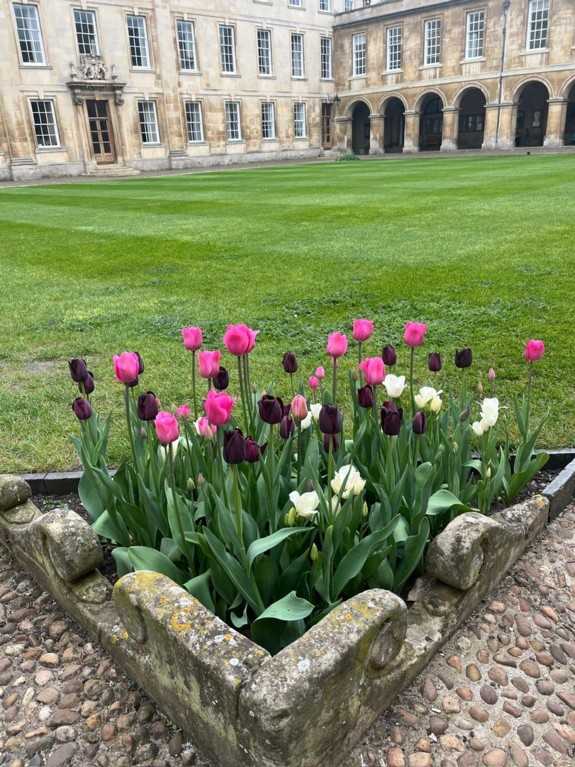
Borders waking up
Fresh shoots of hostas, phlox, asters, and astilbes have been pushing through the soil, and we’ve been mulching steadily to conserve moisture and suppress early weeds. The peonies are showing strong, healthy stems — a good sign for the display to come.
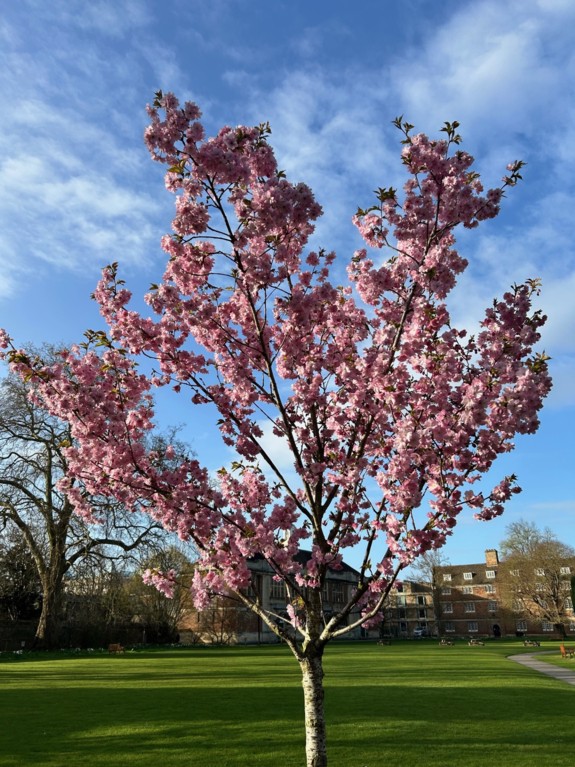
Blossom season
The College’s magnolias have been particularly elegant this year, especially the Magnolia soulangeana near the Jester sculpture. The cherries in the paddock and Chapman’s Garden followed with their usual exuberance, scattering petals across the lawns like a late spring snowfall.
Wildlife returning
The moorhens have resumed their patrols of the pond edges, and the first newts have been spotted in the water. Bumblebees are making excellent use of the pulmonaria, hellebores, and other early nectar sources.
Behind-the-scenes work
Much of April’s work happens quietly, but it’s essential to the health of the gardens:
· Dividing and replanting overgrown perennials
· Repairing edging and gravel paths
· Potting on summer bedding in the glasshouse
· Checking irrigation systems before the dry spells arrive
And this year, a particularly important task:
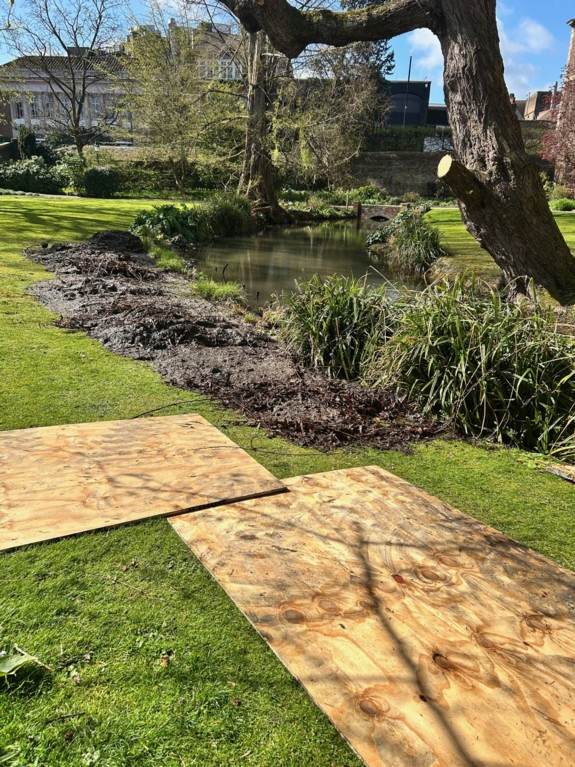
Dredging the conduit streams
To improve water flow and maintain the health of the College’s waterways, the team has been dredging the conduit streams. This is delicate work, and we take great care with the material we remove. The debris and silt are left to drain beside the water, giving the insects and aquatic invertebrates time to crawl back into the stream. Once the living passengers have safely returned, the remaining spoil becomes a valuable ingredient in our composting systems, adding structure and microbial richness. It’s a satisfying example of how small ecological decisions can support the wider garden environment.

May: Full Spring, Full Speed
May is when the gardens truly hit their stride — and when the pace of work becomes almost continuous.
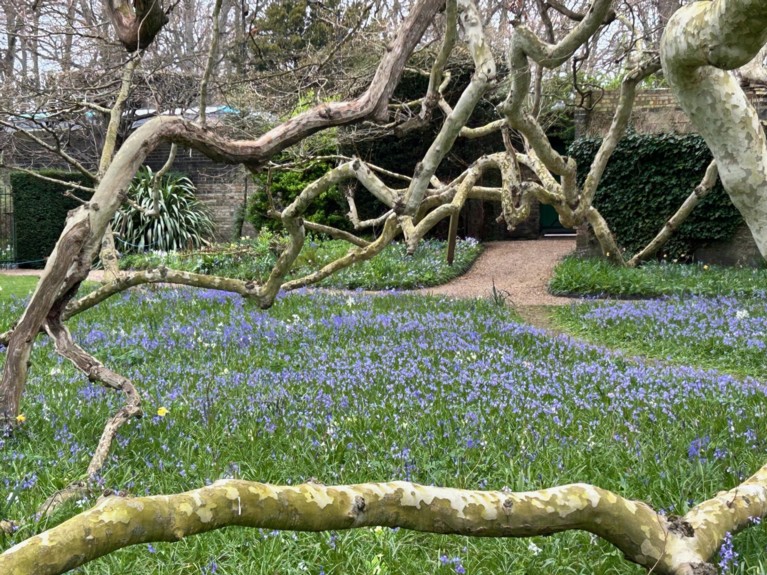
Rhododendrons and azaleas
The Bluebells in the Fellows’ Garden have been spectacular, with deep purples, before the leaf emerging and shadowing the bulbs. The azaleas along the water’s edge by Emmanuel House are now in full colour, their scent drifting across the lawns on warm afternoons.
Lawns and lushness
With longer days and warmer temperatures, the lawns have entered their rapid-growth phase. Mowing becomes a near-daily rhythm, and we’ve begun selective feeding to keep the turf healthy without encouraging excessive growth.
Iris season
The bearded irises are beginning to open, their architectural foliage giving way to rich purples, blues, and yellows. They catch the light beautifully at this time of year.
.jpg)
Planting out
May is also the month when we begin planting out the summer displays:
· Tender salvias
· Dahlias (once frost risk has passed)
· Cosmos and tithonia for height and movement
· Pelargoniums for the more formal containers
The glasshouse empties quickly, and the borders fill just as fast.
Wild corners thriving
Our meadow areas are full of early growth — oxeye daisies, camassia bulbs, red campion, and a variety of grasses that bring softness and movement. These spaces are increasingly important for pollinators, and we’re seeing more species each year.
Looking Ahead
June will bring the next wave of colour: roses forming buds, wisteria preparing its second flush, and the herbaceous borders gathering momentum. For now, April and May have given us a beautiful start to the season.
If you’re passing through the College, take a moment to pause in one of the quieter corners. There’s always something new to notice — and often something quietly at work beneath the surface.
Best wishes
Brendon Sims (Head Gardener)
13 April 2026
.jpg)
W is for…Walnut and Wolfenden
Before fixed names were given to Emmanuel’s buildings and courts at the end of the nineteenth century, a multiplicity of terms were used, many of them short-lived and/or colloquial. A letter written in 1695 by Thomas Dillingham, an Emmanuel graduate, recalled ‘the entry through which we got from the Quadrangle [Front Court] into Wolfenden’s Court’. James Wolfenden, a college Fellow during Dillingham’s undergraduate days, had evidently resided in the narrow courtyard that once occupied the site of the current southern Front Slips. The term ‘Wolfenden’s Court’ is not found in the college’s own records; indeed, the courtyard was known as ‘Long Court’ for most of the eighteenth century. Front Court, in particular, has been known by a variety of names over the centuries. In 1735, Thomas Wiseman, a handyman frequently employed by the college, presented a bill for painting the ‘posts & Rails [in] the Walnutt Tree Court’. An invoice handily submitted at the same time, by a different contractor, refers to mowing the grass in ‘the great court’ and ‘the Eagle court’. As it is known that Eagle Court was what is now called New Court, the logical deduction must be that ‘Walnutt Tree’ and ‘great court’ refer to the same place, i.e. Front Court. This would indicate that the tree that once grew in the centre of that quadrangle, as depicted in David Loggan’s well-known engraving of the late seventeenth century (pictured), was a walnut. If so, this would (alas) quash the romantic theory that the tree was an oak, planted to celebrate Sir Walter Mildmay’s famous metaphor about the college he had founded. While it is unlikely that another tree will ever be planted in the soil of Front Court, it might be worth noting that walnut trees can be successfully grown in pots…
W is for…Westmorland Building
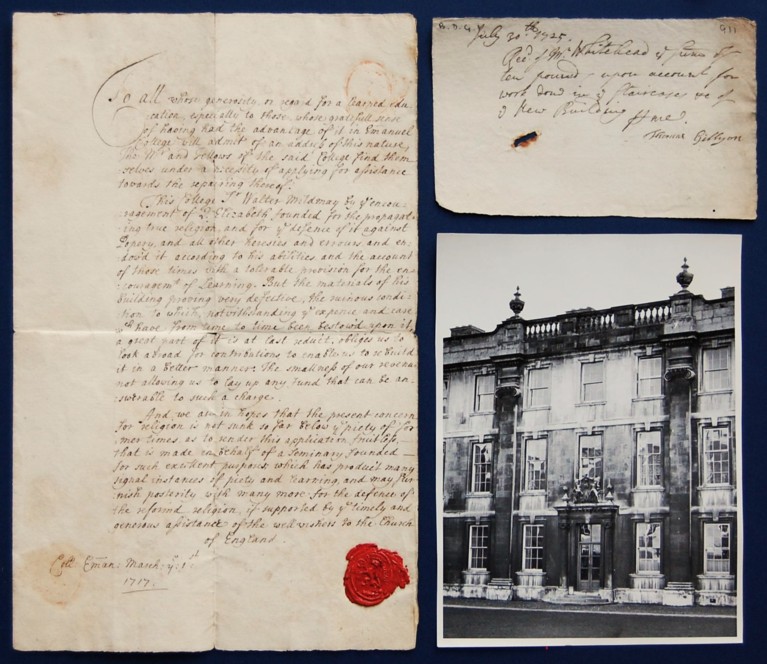
The elegant Classical range on the south side of Front Court, now known as the Westmorland Building, has had an adventurous history. The original building on the site, erected in the mid-1580s, was known for several centuries as the ‘Founder’s Range’. It was said to have been built to a very high standard, and indeed it appears to be in excellent repair in Loggan’s engravings. Yet in 1718, the college sent out an appeal letter to raise funds for the reconstruction of this allegedly ‘ruinous’ structure. Perhaps ‘unfashionable’ might have been nearer the truth. The replacement building, the shell of which was completed by 1722, was furnished with a swish portico over the central staircase entry, surmounted by a carving of what the stonemason referred to as ‘the Founders Coarte of Armes’. The arms are, in fact, those of the Fane family. In 1599, Francis Fane, 1st Earl of Westmorland, had married the heiress Mary Mildmay, granddaughter of Emmanuel’s founder. Two of their descendants were major contributors to Emmanuel’s 1718 appeal: Thomas Fane, 6th Earl of Westmorland, who gave £500, and his brother John, later 7th Earl. Thomas also provided the architect of the new building, in the person of his own estate manager, John Lumley. The Founder’s Range was gutted by fire in 1811, and the under-insured college was obliged to launch another appeal. One of the chief donors to the repair fund was John Fane, 10th Earl of Westmorland. The range was formally renamed the ‘Westmorland Building’ in the late nineteenth century, as a tribute to the earls’ generosity. The image above shows the 1718 appeal letter (left), a contractor’s 1725 bill for work on the staircases of ‘the New Building’, and a photograph taken in about 1960, showing the building’s formerly soot-blackened façade.
Amanda Goode, College Archivist
13 April 2026
W is for…Walnut and Wolfenden
(1).jpg)
Before fixed names were given to Emmanuel’s buildings and courts at the end of the nineteenth century, a multiplicity of terms were used, many of them short-lived and/or colloquial. A letter written in 1695 by Thomas Dillingham, an Emmanuel graduate, recalled ‘the entry through which we got from the Quadrangle [Front Court] into Wolfenden’s Court’. James Wolfenden, a college Fellow during Dillingham’s undergraduate days, had evidently resided in the narrow courtyard that once occupied the site of the current southern Front Slips. The term ‘Wolfenden’s Court’ is not found in the college’s own records; indeed, the courtyard was known as ‘Long Court’ for most of the eighteenth century. Front Court, in particular, has been known by a variety of names over the centuries. In 1735, Thomas Wiseman, a handyman frequently employed by the college, presented a bill for painting the ‘posts & Rails [in] the Walnutt Tree Court’. An invoice handily submitted at the same time, by a different contractor, refers to mowing the grass in ‘the great court’ and ‘the Eagle court’. As it is known that Eagle Court was what is now called New Court, the logical deduction must be that ‘Walnutt Tree’ and ‘great court’ refer to the same place, i.e. Front Court. This would indicate that the tree that once grew in the centre of that quadrangle, as depicted in David Loggan’s well-known engraving of the late seventeenth century (pictured), was a walnut. If so, this would (alas) quash the romantic theory that the tree was an oak, planted to celebrate Sir Walter Mildmay’s famous metaphor about the college he had founded. While it is unlikely that another tree will ever be planted in the soil of Front Court, it might be worth noting that walnut trees can be successfully grown in pots…
W is for…Westmorland Building
.JPG)
The elegant Classical range on the south side of Front Court, now known as the Westmorland Building, has had an adventurous history. The original building on the site, erected in the mid-1580s, was known for several centuries as the ‘Founder’s Range’. It was said to have been built to a very high standard, and indeed it appears to be in excellent repair in Loggan’s engravings. Yet in 1718, the college sent out an appeal letter to raise funds for the reconstruction of this allegedly ‘ruinous’ structure. Perhaps ‘unfashionable’ might have been nearer the truth. The replacement building, the shell of which was completed by 1722, was furnished with a swish portico over the central staircase entry, surmounted by a carving of what the stonemason referred to as ‘the Founders Coarte of Armes’. The arms are, in fact, those of the Fane family. In 1599, Francis Fane, 1st Earl of Westmorland, had married the heiress Mary Mildmay, granddaughter of Emmanuel’s founder. Two of their descendants were major contributors to Emmanuel’s 1718 appeal: Thomas Fane, 6th Earl of Westmorland, who gave £500, and his brother John, later 7th Earl. Thomas also provided the architect of the new building, in the person of his own estate manager, John Lumley. The Founder’s Range was gutted by fire in 1811, and the under-insured college was obliged to launch another appeal. One of the chief donors to the repair fund was John Fane, 10th Earl of Westmorland. The range was formally renamed the ‘Westmorland Building’ in the late nineteenth century, as a tribute to the earls’ generosity. The image above shows the 1718 appeal letter (left), a contractor’s 1725 bill for work on the staircases of ‘the New Building’, and a photograph taken in about 1960, showing the building’s formerly soot-blackened façade.
Amanda Goode, College Archivist