Blog
9 June 2026

Y is for…Yeatman Cup
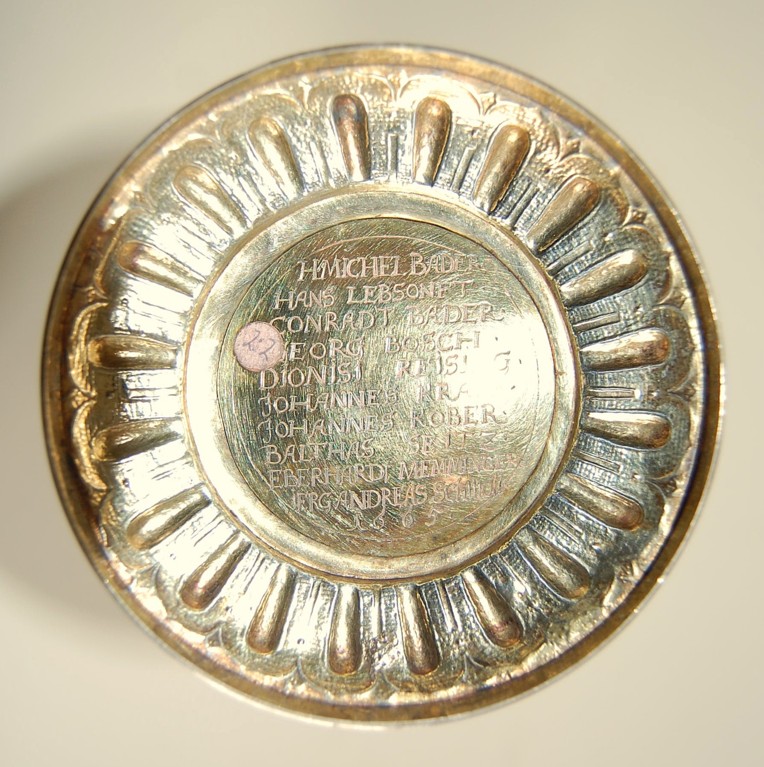
The exact date on which the Emmanuel College Athletics Club was founded is unknown. It was certainly flourishing by the mid-1860s, because in 1868 it was given a silver cup, to be awarded to the best all-rounder in the annual athletics competition. The donor was Huyshe Wolcott Yeatman, who had just graduated BA from Emmanuel. The ‘Yeatman Challenge Cup’ bears the hallmarks of Schemnitz (Slovakia) and incorporates a disc inscribed with ten German personal names and the date 1665 (pictured). The Emmanuel winners of the cup were recorded on a bespoke base, but there is a gap between 1903-1936, because the trophy’s location had become ‘shrouded in mystery’. The prize was, nevertheless, notionally awarded in the early 1920s*. In 1937, the Athletics Club finally discovered that its precious silverware had been placed in safe storage by the college authorities. This revelation aroused considerable resentment, and club members resolved to ask the Bursar whether they could at least borrow the cup on certain occasions, such as the ECAC annual dinner. Ironically, the college’s solicitousness turned out to have been misplaced, as a later valuation pronounced the apparently antique Yeatman Cup to be of nineteenth-century German manufacture, although the disc may be genuine. This begs the question of whether the young donor knew that his gift was a modern piece. In 1905, Yeatman was made an honorary Fellow of Emmanuel, following his appointment as Bishop of Worcester. He was later translated to Coventry, where he died. His bronze tomb was the only monument in Coventry Cathedral to survive the devastating air raid of 14 November 1940.
* The winners, whose names were never inscribed on the base, were Albert Childs (1920), William Morris (1921) and Thomas York (1922 and 1923). The cup seems not to have been awarded after 1964.
Y is for…Young
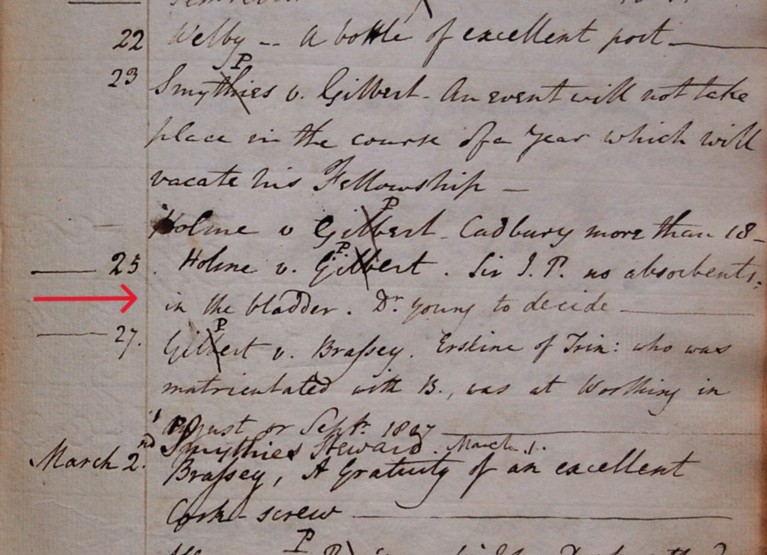
Many biographies of Emmanuel’s most celebrated member, the polymath Thomas Young, contain minor inaccuracies about his residence in Cambridge. Young was already a qualified physician when he was admitted to Emmanuel in 1797, but he needed to spend at least two more consecutive years at a university in order to gain admission to the Royal College of Physicians. This, and Young’s declaration that he intended to stay the minimum amount of time at Cambridge, have led some authors to believe that he resided for only two years. Young himself later noted, however, that he stayed for three, and in fact he remained on the college books until December 1802, to satisfy the University’s M.B. requirements. Another statement sometimes encountered is that Young did not come into residence until October 1797, seven months after his formal admission on 18 March. The Parlour wager books show, however, that he was certainly in college on 28 March, and the student account registers indicate that he resided for at least part of Easter Term 1797. This is important, because it confirms that Young’s famous introduction to the Fellows by the Master, as a ‘pupil qualified to read lectures to his tutors’, can confidently be attributed to Richard Farmer, rather than his successor, as has been suggested (Dr Farmer, a long-time friend and supporter of Young, died in September 1797). On 22 February 1800, just before he went out of residence, Young presented the Parlour with a parting gift of seven bottles of old Port, but that was not to be his final evening at Emmanuel. In February 1808, as recorded in the wager book, Young was asked to decide the winner of a bet concerning Sir Isaac Pennington, Regius Professor of Physic at Cambridge. The entry (pictured) refers to him as ‘Dr Young’, because the great man was in town to receive his M.D.
Amanda Goode, College Archivist