
Blog
7 July 2026

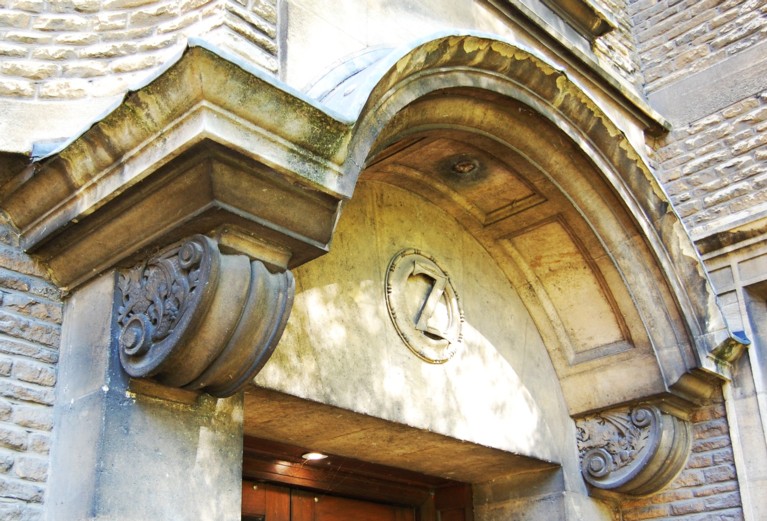
The factor linking these two disparate-sounding entities is the architect Leonard Stokes, who designed two acclaimed buildings at Emmanuel: the Library (formerly the New Lecture Rooms) and North Court, completed in 1909 and 1913 respectively. Both buildings were adorned with carvings of the highest quality. Those in North Court were the work of London-based sculptor Abraham Broadbent, and as Stokes used his services frequently, it seems likely that Broadbent had also executed the Library carvings. The most attractive of these are the twelve bas-relief stones, depicting the signs of the Zodiac, set into the arches over two of the ground floor windows. The college considered them to be ‘a charming piece of sculpture, which not all members…have noticed as they deserve’. North Court’s carvings are equally eye-catching, especially the heraldic monsters supporting the cambered hoods over the staircase entries. These fearsome-looking beasts are carved in the same bas-relief style as the Zodiac sculptures, and fun can be had distinguishing between dragons, gryphons and wyverns. North Court stairways Q, R, S and T were ready for occupation by Michaelmas 1913, but X, Y and Z were not finished until the summer of 1914. (Letters U, V and W were omitted as they were thought to be too similar-looking, but in the 1960s ‘W’ was assigned to the staircase in the North Court porters’ lodge, after it had been converted to residential use.) Several sets in the court were reserved for Fellows, one of the most gracious being Z8 (now Z16). It was occupied for most of the period between 1914 and 1948 by Leonard Greenwood, a New Zealander appointed in 1909 to teach Classics. The informal drop-in musical evenings he hosted in Z8 every Sunday became a college institution.
Z is for Zumpe piano
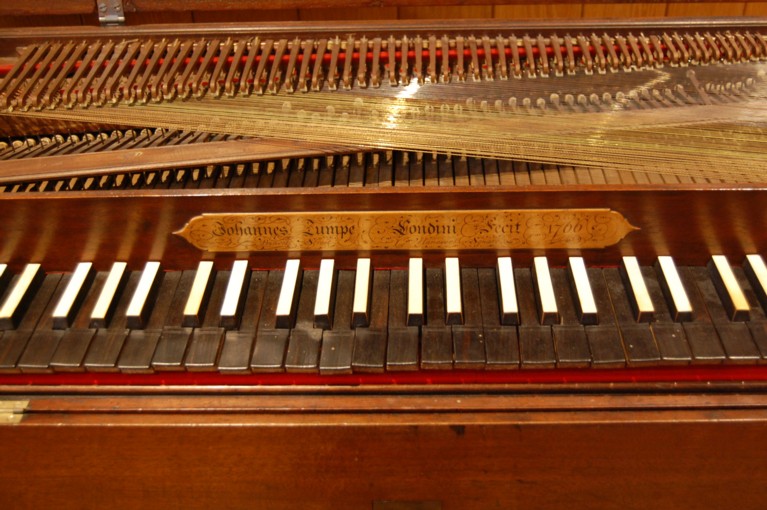
In a corner of a music room in the Queen’s Building stands an instrument of humble appearance, but great historical significance. Manufactured in 1766, it is one of the oldest surviving English-made ‘square’ pianos. The maker was German-born Johannes Zumpe, who emigrated to London in about 1760 and set up a musical instrument shop near Hanover Square. The piano was given to the college in 1985 by the sons of Edward Woodall Naylor. In 1898, their father had been appointed Emmanuel College organist and lecturer in music, a unique appointment in Cambridge at that time. Emmanuel made him an Honorary Fellow in 1920. Naylor’s principal interest was in early music, which was then a rather unfashionable field of study. His hand-drawn posters showing seventeenth-century musical instruments and musicians, which he used as lecture aids, are preserved in the college archives. He was also a composer, and his music MSS are held in the library’s special collections. According to Naylor, the Zumpe piano ‘was bought when new by my maternal ancestor, the horticulturalist [William] Bean, who kept a garden with a concert hall at Scarborough in the mid-Eighteenth century’. Naylor’s sons took great care of the piano after their father’s death in 1934, but eventually decided that it should have a permanent, secure home at Emmanuel College. The instrument required some restoration, and its strings and some wooden innards had to be replaced, although they have been carefully preserved. Unfortunately, the piano is not currently in working order. The three earliest surviving Zumpe pianos bear the date 1766, and two of them, including Emmanuel’s, are evidently experimental prototypes.
Amanda Goode, College Archivist