Blog
17 September 2026

The portraits on Emmanuel’s walls – now over 150 in number – represent a serendipitous legacy from past donations, bequests and the occasional commission. Only since the late 1980s has Emmanuel even had a consistent policy of commissioning portraits of Masters. But there is one sub-set among the portraits that is evidently the outcome of a settled policy. These are the copies of portraits of various Emmanuel-related worthies, commissioned between 1775 and 1790 from a single artist – Joseph Freeman (1729-99) – and probably a reflection of sentiment associated with the College’s bi-centenary in 1784.
As a group, these eleven portraits can offer an intriguing snapshot of the predecessors that Emmanuel regarded as worth commemorating at that point in time. Needless to say, those chosen predecessors include some entirely forgotten as well as some still remembered. They include two philosopher-theologians, three other churchmen, a wealthy businessman and philanthropist, an eccentric astronomer, two recent and long-serving ‘college men’ (a tutor and a Master), and a prominent figure in the Civil War of the previous century (but they got the wrong one). Oddly at first sight, seven of these eleven portraits are copies of portraits that the College already owned. It would seem that the motive was to create a series of uniform size and uniformly framed to hang as a set in the Fellows’ Parlour. In accounts for 1788 Freeman is paid for five ‘Three Quarter Pictures at four guineas each’ and seven Carlo Maratta gilt frames for £12.12s.6d.
For the Parlour – which during the Mastership of Richard Farmer (1775-97) was something of an intellectual salon – a portrait of the College’s Founder was needed. Freeman slightly softens the grave, not to say pinched, expression of the forbidding Puritan assumed by Sir Walter Mildmay in all other known portraits.
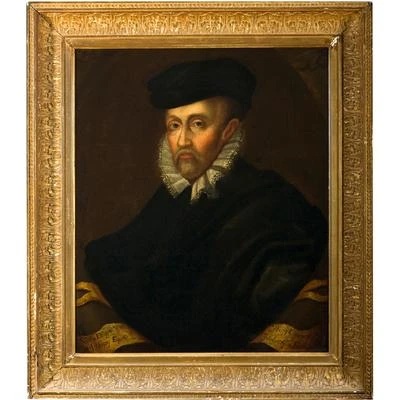
But in his copy Freeman did not soften the College’s larger portrait of a grave-looking Francis Ash (fl. 1645-60), which is now in the Hall.
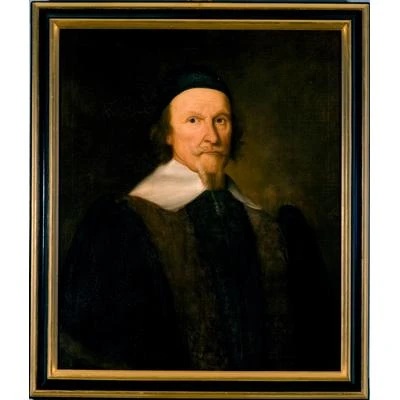
A City of London alderman, Warden of the Goldsmiths and Master of the Muscovy Company, Ash was never a student at Emmanuel but was an exceptionally generous benefactor to the College as part of his annual charitable donations totalling the then stupendous sum of £300.
The portraits of Benjamin Whichcote (1609-83) and Ralph Cudworth (1617-88) depict Emmanuel members of what are now called ‘The Cambridge Platonists’.
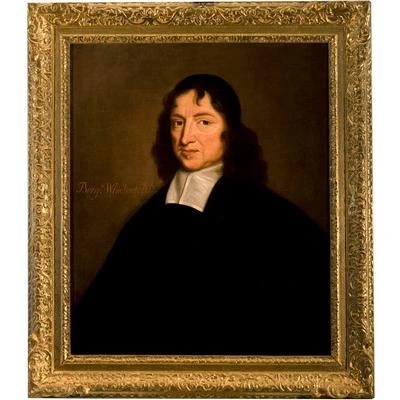
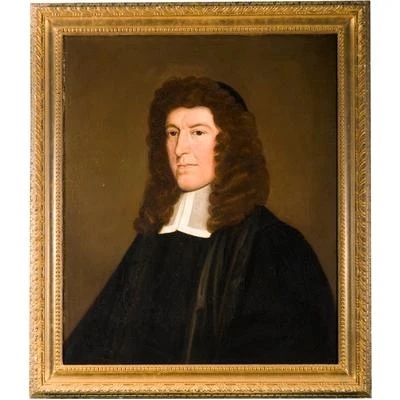
This group of Cambridge philosophers and theologians believed that religion and reason were in harmony and used reason to unite Christian belief with Platonism. Whichcote held that as the child of reason mankind is not wholly depraved by nature as Puritans believed, and argued for religious toleration. Cudworth was perhaps the most learned of all the Platonists, his magnum opus being entitled The True Intellectual System of the Universe. Freeman’s copies are very much shaped by the quality of the portraits that he was copying. For Whichcote, he had the College’s fine portrait by the pioneering woman portraitist Mary Beale to work from. For Cudworth, he had perhaps contemporary drawings that were later engraved, and the difference in inspiration is very obvious.
Similar variations deriving from the copy’s original are to be seen in three portraits of churchmen. John Sudbury (1604-84) had entered Emmanuel in 1620 and went on to be Dean of Durham (1661-84), repairing the cathedral fabric and building a library.
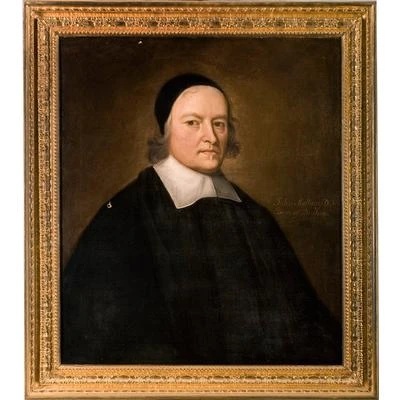
He endowed a Greek lectureship at Emmanuel and an annual prize (in silver) for the best commencing bachelor, which long continued as a prize in the form of silver. This is a copy of a copy: Freeman copied the College’s existing portrait, itself probably copied from one at Durham.
By contrast, the Freeman copy of the portrait of George Thorp (1638-1719), a major benefactor, reflects the excellent quality of the College’s original portrait by Mary Beale.
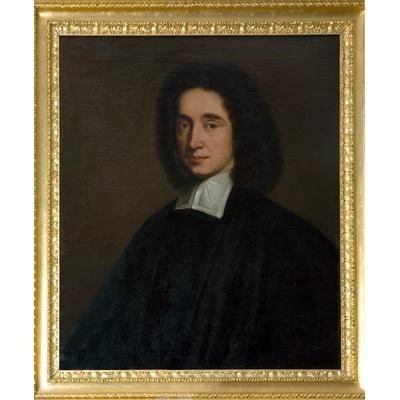
A third churchman is John Peter Allix (1679-1758), a local vicar, of nearby Swaffham Prior.
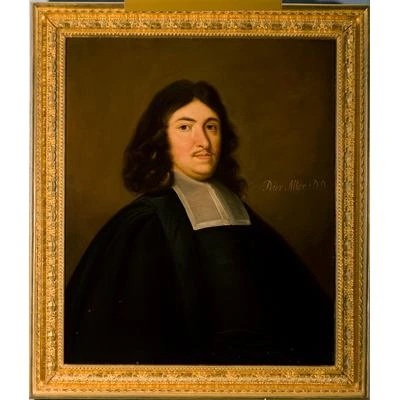
His only connection with Emmanuel was that his father, Pierre Allix, was a distinguished French Protestant divine, and refugee in England, who took a Cambridge Doctor of Divinity degree from Emmanuel in 1690 – it is tempting to think that Freeman copied the wrong Allix…
The same quality difference depending on the original marks two portraits of recent loyal College officers: William Richardson, Master for nearly forty years (1736-75) and Henry Hubbard (1707-78), a tutor for thirty five years.
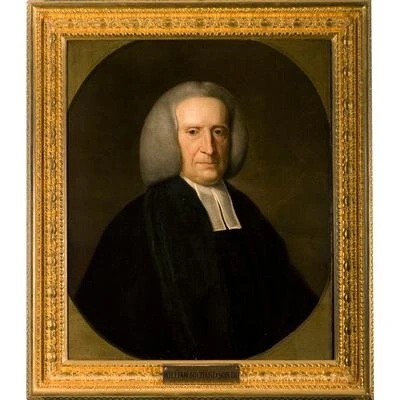
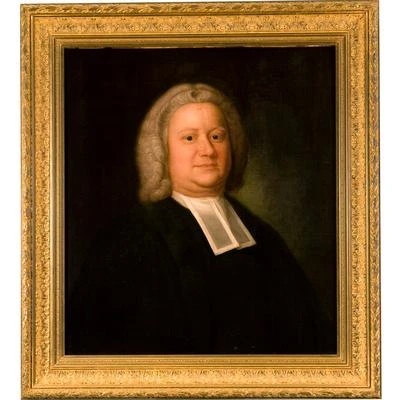
With Richardson, Freeman is copying the College’s larger portrait, now in the Hall and probably by one of the van der Mijn family of Dutch artists working in England in the eighteenth century. With Hubbard, Freeman is copying a portrait by Gainsborough, possibly the year before its owner bequeathed it to the College.
There is also a quality from the original in Freeman’s copy of the portrait by the American artist Benjamin West of Roger Long (1680-1770), the first Lowndean Professor of Astronomy and long-serving Master of Pembroke.
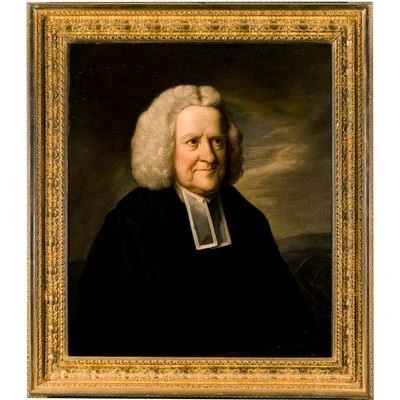
Long had had only the briefest connection with Emmanuel at the start of his career, but was recruited to the portrait-pantheon of Emmanuel worthies. Perhaps this was because he was one of the great characters of eighteenth-century Cambridge, building a ‘water-work’ in his garden, around which he exercised, paddling on a ‘water-cycle’, and also constructing the first planetarium, a hollow sphere that could hold 30 people and showed the movement of the planets and constellations. It survived in the Pembroke gardens until 1871.
In the last of the set of copies, an attempt to include an Emmanuel figure from the Civil War period produced only a case of mistaken identity.
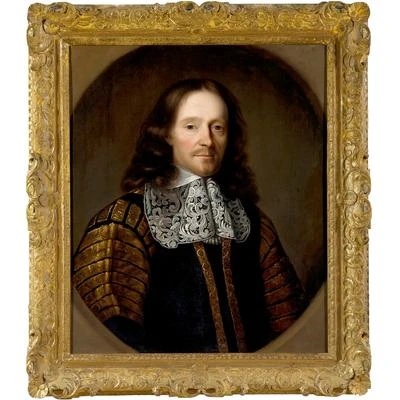
What Freeman copied for the College as a portrait of Sir John Finch, who entered Emmanuel in 1596 and was variously Commons Speaker, Chief Justice and Lord Keeper, actually turns out to be a portrait of Arthur Annesley, Earl of Anglesey (1614-86), who never had any connection with Emmanuel. The silver lining is that Freeman’s copy reflects the quality of the excellent original – now in the National Portrait Gallery – by the Anglo-Scottish painter John Michael Wright (1617-94), whose work is increasingly valued. Before photography, identification of sitters and attribution to artists was necessarily laborious and prone to error.
In c.1790 a survey of the pictures in Cambridge colleges records that the Fellows’ Parlour was decorated with six copies by Freeman, presumably in those smart matching frames: Sir Walter Mildmay, Francis Ash, Henry Hubbard, John Sudbury, George Thorp and Benjamin Whichcote. Nowadays the Robert Gardner Room displays an almost complete set of the Freeman copies as a permanent exhibition of this fascinating moment of Emmanuel remembering its past.
Barry Windeatt (Keeper of Special Collections)